What is the Difference between Cut-Resistant vs Stab-Resistant Clothing
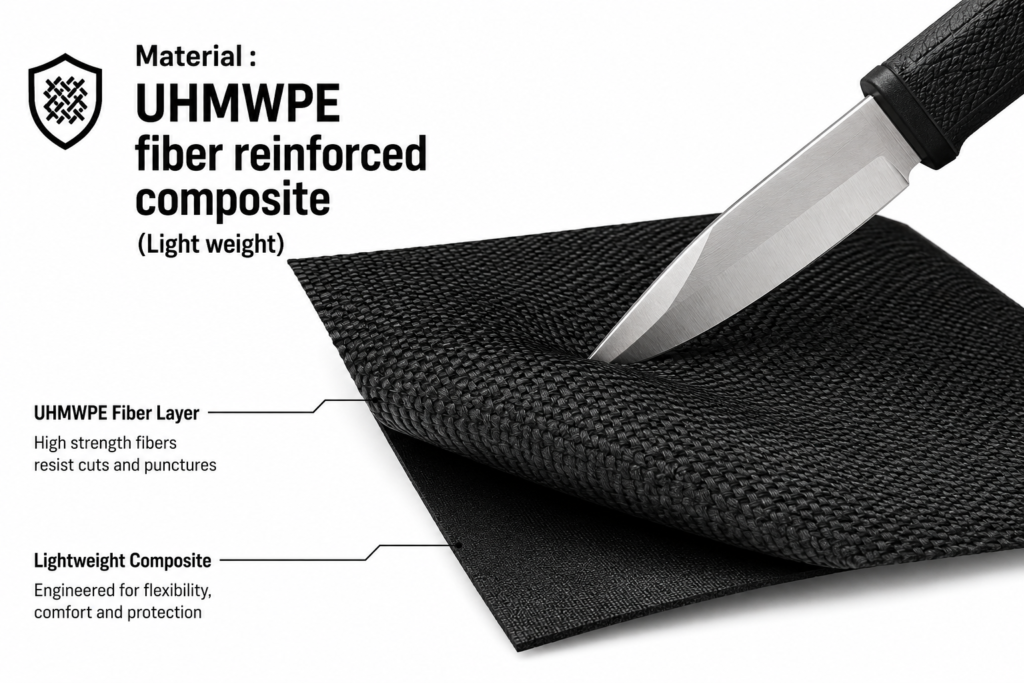
The most useful thing to know before comparing protective clothing is what its evidence does—and does not—cover.
Protective clothing is not one single kind of protection. A garment described as cut-resistant is not automatically stab-resistant, and a claim about a material does not necessarily tell you how a finished shirt, hoodie or vest performs.
The difference is the hazard being assessed. Cut resistance concerns resistance to a specified cutting action along a surface. Stab resistance concerns resistance to a specified penetration hazard involving a pointed object. A test for one does not, by itself, demonstrate the other.
That distinction matters if you are comparing clothing for personal use, security work or an employer’s PPE assessment. The label is only a starting point. You also need to know which test method and version were used, whether the complete garment or only a material sample was tested, what areas are covered, and what the result does not mean.
This guide explains those questions in plain English. It does not promise that any garment can prevent injury. Protective performance depends on the tested product, its design and fit, the defined test conditions, its care and its intended use. A real incident may differ substantially from a laboratory test.
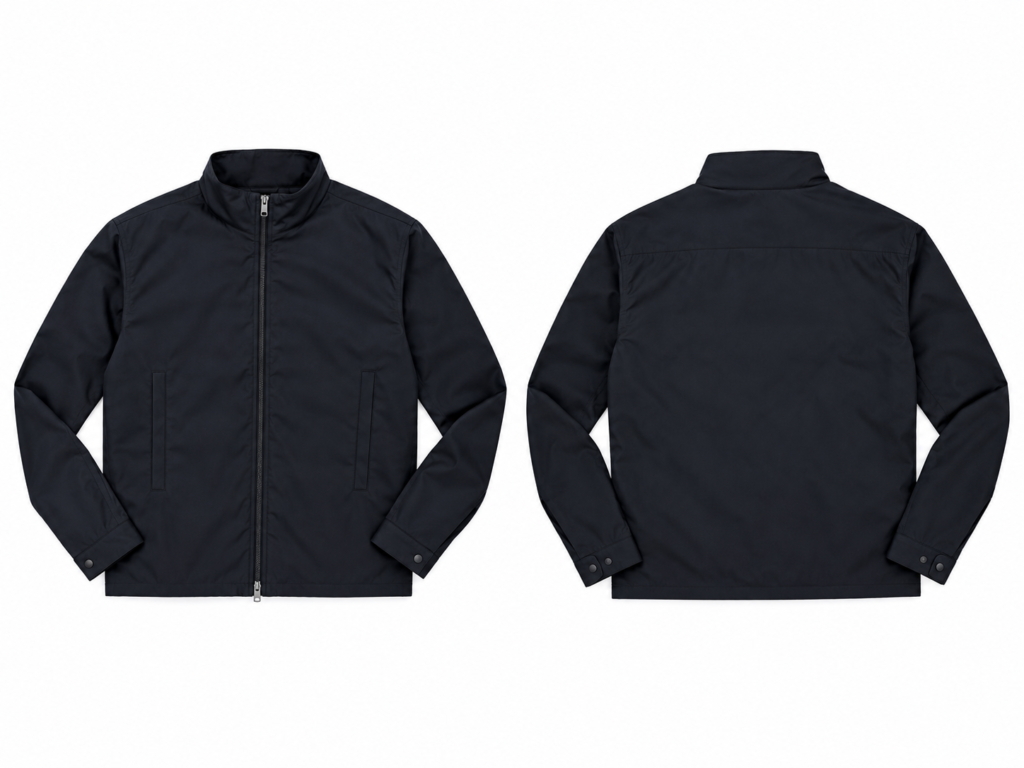
Smart casual stab proof jacket
Cut-resistant vs stab-resistant clothing at a glance
| What to compare | Cut-resistant clothing | Stab-resistant clothing |
| Hazard addressed | A specified cutting action, usually a sharp edge moving against a material under defined conditions. | A specified penetration hazard using a defined test method and test object. |
| Plain-English distinction | Resistance to a blade travelling across or through a surface in a controlled test. | Resistance to a point entering a tested material or product under defined conditions. |
| What evidence may show | Results for a particular cut test, material or product configuration. | Results for a relevant penetration test on the material or complete garment, as stated in the report. |
| What a buyer should request | Standard and version, result, tested sample, test laboratory, report identification and limitations. | The same details, plus a clear explanation of the penetration test hazard and product coverage. |
| What the label alone does not establish | Puncture or stab resistance, complete-garment performance, or protection outside the test conditions. | Resistance to every point, blade, impact, incident or body-area hazard. |
| Why design matters | Seams, openings, fit and uncovered areas may not behave like a flat fabric sample. | The tested area, garment construction, closures, fit and coverage define how far results can be applied. |
In brief: Cut-resistant clothing is designed and tested for resistance to cutting hazards. Stab-resistant clothing is designed and tested for resistance to specified penetration hazards. Neither label alone tells you everything about a garment’s performance.
Learn what to look for before you buy: read StabApparel’s existing testing guidelines alongside the evidence checklist below. The page itself should be reviewed and corrected wherever it implies that a cut rating proves stab resistance.
What is cut-resistant clothing?
In everyday language, cut-resistant clothing is intended to resist a defined cutting action better than an otherwise comparable material. The key word is defined. A laboratory test applies a particular method to a prepared sample under controlled conditions. Its result describes performance in that test; it is not a universal guarantee against every sharp object or use.
A cutting action and a penetration event ask different questions. In one situation, an edge travels across a surface and may slice through fibres. In another, a point applies force into a small area. Materials can respond differently to those forms of loading. A textile that performs well in a cut test may still have unknown performance against a pointed object unless relevant penetration testing has been carried out.
Textile structure can affect results. Fibre type, yarn construction, weave or knit, layers, coatings and the way the fabric is assembled all matter. But a material name—such as a high-strength polymer—is not a test result. Nor does a fibre’s strength tell a buyer how a specific garment behaves across its whole area, at a seam or around an opening.
The configuration matters too. A test result for a fabric swatch applies to that swatch under the test conditions. It does not automatically transfer to a different fabric weight, colour, size, manufacturing batch or garment. When a material is incorporated into clothing, construction choices may change the tested configuration. A report should identify what was tested clearly enough to connect its result to the item offered for sale.
The test itself also has boundaries. It may focus on a particular direction, blade type, load, conditioning procedure or endpoint. Those details define the result. A number without the method and unit is difficult to interpret, and comparisons between results are only meaningful when the methods and conditions are comparable.
A product description is not the same as substantiation. Phrases such as “cut proof”, “level 5” or “tested” should lead to precise questions: tested using which standard, which edition, by whom, on what sample and with what outcome? A seller should be able to explain whether a number belongs to the fibre, a fabric panel, a glove or the finished garment.
Cut-resistance buyer checklist
•Identify the exact cut hazard and the protective property being claimed.
•Ask for the test method and edition, including any relevant product standard that applies it.
•Confirm whether the report covers the fabric, a component or the finished garment.
•Match the product name, model and configuration in the report to the item being sold.
•Check units, result, conditions, report date and limitations.
•Check which garment areas are covered and whether evidence says anything about seams or openings.
•Do not infer stab or puncture resistance from a cut result alone.
What is stab-resistant clothing?
“Stab-resistant” is a claim about resistance to a specified penetration hazard. The test must define what is applied, how the material or product is supported, how force or energy is controlled, where and how often measurements are taken, and what counts as penetration. Different methods can represent different hazards. A result under one method should not be treated as proof against every pointed object or real-world event.
The general engineering challenge differs from resistance to a blade moving across a surface. Penetration focuses force on a relatively small area. The response can depend on how the tested construction distributes that force, resists separation or otherwise behaves under the prescribed setup. The material name alone cannot predict the outcome of the finished product.
A garment is a system, not a loose piece of fabric. The outer layer, any protective insert or reinforcing component, lining, stitching, closures and shape all contribute to what is being sold. A report on one material panel may be useful evidence about that panel, but it should not be rewritten as a result for every garment made with it. If only a material sample has been tested, the product description should say that clearly.
Coverage also matters. A tested front panel does not prove that the back, side, sleeves, hood, seams or openings provide the same performance. A T-shirt and a long-sleeved top do not cover the same areas. More coverage is not the same as a higher test result, and no garment covers every part of the body. Buyers should look for an accurate coverage diagram and a written description of areas that are not protected by the claimed component.
Fit and use affect whether a product remains in its tested condition. A garment that is too tight, too loose, altered, damaged or worn in a way not covered by the report may not correspond to the tested configuration. Follow the manufacturer’s care, inspection and replacement instructions. If the instructions are missing, ask before buying rather than assuming ordinary laundering is harmless.
Most importantly, a laboratory test is not a promise about unpredictable incidents. A defined test can provide controlled, repeatable information, but real events can differ in object, angle, force, location, garment fit, condition and many other factors. No label should be understood as making a wearer invulnerable or guaranteeing that injury will be avoided.
Do not test protective clothing at home. An improvised demonstration is not a substitute for a competent laboratory test and could result in injury. Ask the seller for the documentation instead.
Why cut resistance and stab resistance are not interchangeable
Think of the difference as two separate engineering questions. One asks how a material responds when a sharp edge moves across it in a specified way. The other asks how it responds when a defined pointed-object hazard presses into it. The questions may involve related materials, but answering one does not answer the other.
A simple analogy is a raincoat and a windproof jacket: the properties may overlap, but evidence for one does not automatically verify the other. The analogy is only a prompt for thinking; material performance must be established with the relevant test method, not by comparison or intuition.
The standards make this distinction especially important. BSI describes BS EN 388:2016+A1:2018 as a standard for protective gloves against mechanical risks. Its listed requirements cover abrasion, blade cut, tear, puncture and, where applicable, impact. BSI says the methods may also apply to arm protectors. That does not mean an EN 388 result on a glove establishes the performance of a hoodie or T-shirt.
BSI’s listing for BS EN ISO 13997 describes a TDM cut test for materials and assemblies designed for protective clothing, including gloves. The scope says that the method does not provide data on penetration by pointed objects, including the point of sharp-edged blades. At the time this guide was checked, the specific BSI record surfaced as “BS EN ISO 13997:2023 – TC” was marked withdrawn on 30 October 2024. Because standards can be revised or replaced, confirm the currently applicable edition and product-specific requirements with BSI and the testing laboratory before naming it as current.
Myth versus fact
Myth: “If clothing resists cuts, it must resist stabs.” Fact: A cut test and a penetration test assess different actions. A cut result alone does not establish stab resistance.
Myth: “Thicker clothing always offers better protection.” Fact: Thickness alone is not a performance rating. Construction, tested configuration, fit and relevant evidence matter. Do not infer protection from appearance.
Myth: “A product description is the same as independent test evidence.” Fact: Marketing copy is a claim. A test report records what a laboratory tested and found. A buyer needs enough detail to connect the report to the exact product.
Myth: “A tested material means the finished garment has been tested.” Fact: Not necessarily. The evidence may concern only a raw material or a sample. Ask what product configuration appears in the report.
Myth: “Protective clothing covers every part of the body.” Fact: Garments cover specific areas. Sleeves, openings, seams and unprotected regions should be described accurately.
How protective clothing is tested
Standardised testing aims to make measurements repeatable. The method describes how to prepare and condition the test piece, what equipment and procedure to use, how to record the result and, often, how to classify it. A standard can reduce ambiguity, but it does not make two different tests interchangeable. Nor does it mean every product carrying a similar label has been tested in the same way.
Start with the scope. A standard’s title and scope explain the type of product, hazard and method it addresses. EN 388 is titled “Protective gloves against mechanical risks”. It is relevant to gloves and includes several mechanical-risk tests. BSI says its methods may also apply to arm protectors. A reference to an EN 388 rating on a garment should therefore be checked carefully: what exactly was tested, and under what product requirement was that method applied?
Cut testing is one part of mechanical-risk testing. EN ISO 13997 is a TDM method for determining resistance to cutting by sharp objects. BSI’s description makes its limit explicit: this method does not provide data on penetration by pointed objects. So even where a cutting method is relevant to protective clothing, it cannot alone substantiate a stab-resistance claim.
A puncture test also needs interpretation. A test may use a particular probe, setup and endpoint. The word “puncture” on a chart or rating does not, without further documentation, tell you that a product passed a test for knife penetration. The report and applicable product standard must identify the method and the hazard it represents. Never relabel a result to make it sound broader than it is.
For a stab or knife-penetration claim, ask the supplier which exact test method and version supports it, and whether the method is intended for the type of garment being offered. If the supplier cites a body-armour standard, technical specification or law-enforcement test protocol, check whether it applies to that product category and threat type. Do not assume that a standard for body armour automatically applies to a casual shirt or that a rating can be transferred between products.
Four kinds of evidence are often confused:
1.Laboratory test: a procedure performed on a sample or product. It may or may not be independent, accredited or relevant to the claim made.
2.Test report: the documented record of the method, sample, conditions and results. It should be traceable to the item sold.
3.Certification or conformity assessment: a separate process against defined requirements. Its meaning depends on the scheme, product, scope and issuing body. A test report is not automatically a certificate.
4.Manufacturer’s declaration or marketing statement: a statement made by the supplier or manufacturer. It can be useful, but it is not a substitute for the test evidence needed to support an objective claim.
For workplace PPE, UK Health and Safety Executive guidance says selection should consider who is exposed, what they are exposed to, duration and extent. It advises checking suitability with the supplier, seeking specialist advice if in doubt, considering size, fit, compatibility and weight, and training workers on use and limitations. PPE is part of risk control, not a replacement for assessing and reducing the hazard.
UK advertising rules are also relevant to product descriptions. The Advertising Standards Authority says advertisers should hold documentary evidence before publishing objective claims consumers are likely to regard as factual. That is a useful discipline for safety-related copy: retain the report, understand its scope and make wording no broader than the evidence.
Learn what to look for before you buy: review the existing StabApparel testing-guidelines page and request the underlying reports for the specific garment, not just general information about a material.

Undetectable Knives and Blades
How to assess a stab-resistant clothing claim
Use this checklist before relying on a claim. Not every test method assesses every feature below; treat the questions as a way to distinguish documented facts from points that need clarification.
1.What exact protective property is claimed? Is the wording about cut, puncture, penetration, stab or several separate properties?
2.Which test method and version were used? Ask for the precise designation, edition and any classification rules.
3.What was tested? Was it a raw fibre, fabric panel, protective insert, finished garment or multiple components?
4.Who performed the test? Request the laboratory’s name and the scope or accreditation details relevant to that test, where applicable.
5.Can the report be traced to the item sold? Check the model, product code, size or material configuration and report date.
6.What conditions and result are documented? Ask for the test conditions, units, results, classification and any uncertainty or limitations the report states.
7.Which parts of the garment are covered? Look for a clear diagram or written map, not an implication of full-body coverage.
8.Are seams, closures and other features addressed? If they were not part of the test, the supplier should not imply they were.
9.How should the product be cared for? Request washing, storage, inspection, repair and replacement instructions. Confirm which changes could invalidate the evidence.
10.What are the limitations? Ask what the result does not establish, including untested threats, areas, sizes or use conditions.
A seller may be unable to share a complete report for commercial reasons. In that case, ask for a redacted version or a concise signed summary identifying the product, method, result, laboratory and limits. A bare rating, logo or certificate number without a way to verify its scope is not enough to understand what the claim means.
Sample questions to send a retailer
I’m considering the
. Please confirm which protective properties are claimed and provide the exact test method and edition supporting each one. Was the finished garment tested, or only a material sample? Please identify the laboratory, report date and product code, explain which areas are covered, and share the care instructions and limitations. If the report is confidential, can you provide a redacted report or a traceable summary?
How to choose the right protective garment for your needs
Start with the intended use and the hazard assessment, not the product category or a dramatic headline. For personal purchases, write down what you want the garment to do, which areas you expect it to cover and what level of evidence you need before comparing products. If your requirement is workplace-related, follow the employer’s risk assessment and involve the appropriate health-and-safety professional.
Compare the specific claim with the evidence. A product that is described as both cut-resistant and stab-resistant needs relevant support for each claim. If a page only presents a cut rating, do not assume the separate penetration claim has been substantiated. If evidence describes a material panel, do not assume the whole garment has the same result.
Coverage and fit are practical as well as technical questions. Check product diagrams, available size information and whether the garment can be worn in the tested configuration. Think about how it fits with other PPE, uniform items or required equipment. An uncomfortable item may not be worn consistently; that is a reason to raise fit and usability during selection, not a reason to guess about protection.
Ask about care before buying. Washing, heat, abrasion, repairs, alterations or routine wear may affect materials or construction. Follow the manufacturer’s instructions and do not assume that ordinary washing or tailoring is compatible with the tested design. If care guidance is unclear, get the answer in writing.
Consider price, sizing, returns and technical support too. These are not proof of performance, but they affect whether you can make an informed purchase and use the product as intended. Check the currency and destination-specific delivery terms: the StabApparel storefront reviewed displayed product prices in US dollars and described itself as US-based. UK buyers should confirm current UK pricing, taxes, import arrangements, delivery, returns and support directly with the retailer before ordering.
For employers, clothing should not be treated as a complete safety plan. HSE guidance puts selection within a risk-management process and recommends choosing PPE that suits the worker and task, with attention to fit, compatibility, weight, instruction and limitations. Seek specialist advice where the hazard or evidence is uncertain.
Questions to ask before buying from any brand
Use the same questions for every retailer so the comparison is fair:
•What exact protective property is claimed, and what is the relevant test method?
•Does the test report apply to this model and the product configuration being sold?
•Was the complete garment assessed, or only a fabric sample or component?
•What does the method cover, and what does it expressly not cover?
•Which areas are included, and which remain uncovered or unverified?
•Are the seams, closures and garment sizes covered by the same evidence?
•Are care, inspection, repair and replacement instructions available?
•Is the result described without turning a test outcome into a guarantee?
•Can technical support explain the report in plain English?
•Are price, currency, delivery, taxes, returns and sizing clear for a UK order?
A helpful seller should be able to distinguish a test result from a product promise. If the answer is only a slogan, a material name or an unexplained level, pause and request evidence. You do not need to buy a product to make a responsible decision about whether its claims are clear enough for your needs.
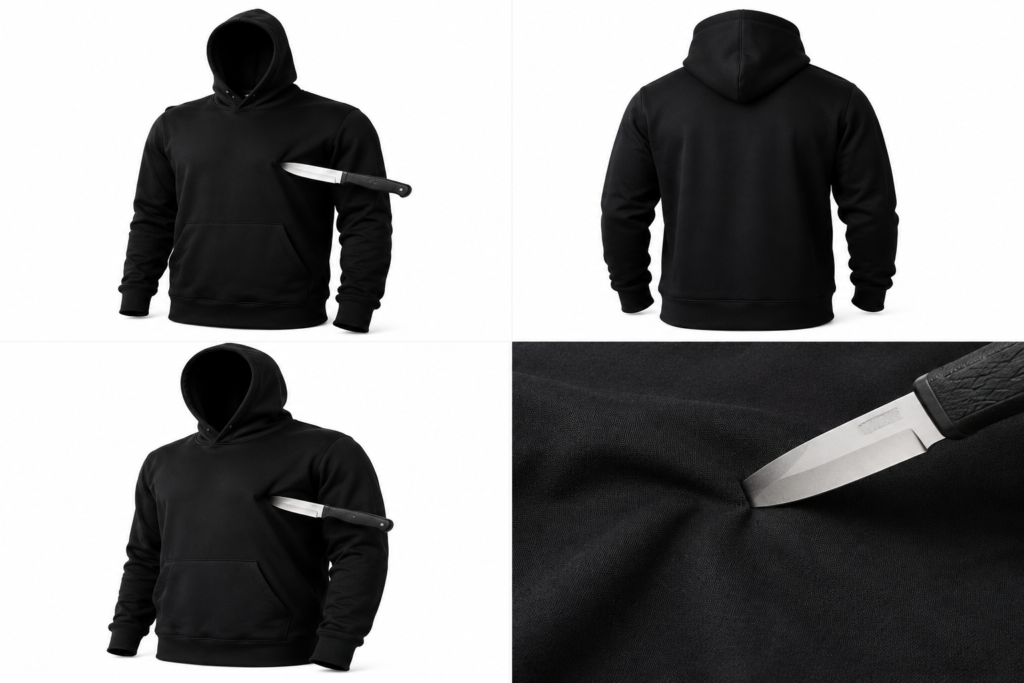
How StabApparel fits into your research
StabApparel’s live site lists clothing such as T-shirts, hoodies, long-sleeved shirts, vests and polo shirts. The reviewed storefront showed product pages for a T-shirt, hoodie and long-sleeved shirt. These links help readers inspect current product descriptions; they are not endorsements or confirmation that a stated performance claim has been independently verified.
The site’s public copy includes claims about cut ratings, puncture performance and protection, including references to EN 388. The BSI listing says EN 388:2016+A1:2018 concerns protective gloves against mechanical risks; BSI’s TDM cut-test description expressly says it does not establish penetration resistance by pointed objects. A reference to either standard should therefore be explained in relation to the exact garment and evidence. A glove rating or a cut-test result must not be presented as proof that a shirt or hoodie resists stabbing.
During this review, the public product and editorial pages inspected did not expose a traceable report or certificate that could be matched to the exact garments. That is a limitation of this desk review, not a finding that no documentation exists. Before publication, StabApparel should obtain the relevant reports from the supplier or test laboratory and verify the product code, sample, method, outcome and limits. If no relevant product-specific evidence can be provided, remove or qualify the claim rather than implying that documentation exists.
The current site also presents mixed market signals: it refers to a US business, lists prices in US dollars and has a UK-themed guide and UK contact details. The reader should verify actual UK availability, delivered price, applicable taxes and duties, sizing, returns and support. The current returns and exchanges page can be linked, but shipping and returns terms should be rechecked before this guide goes live because they may change.
A fair next step is to compare product descriptions with the actual report for each selected item. Readers can use the T-shirt page or hoodie page to identify the model they are considering, then ask for the evidence described in this guide. Product availability, size choices and prices can change; verify the live page at the time of purchase.
Contextual product link: “View the StabApparel T-shirt product details and ask the retailer which report, if any, applies to your selected size and model.” Use this only after the page has been reviewed and product evidence is available or its absence is made unmistakable.
Frequently asked questions: Cut-Resistant vs Stab-Resistant Clothing: What’s the Difference?
What is the difference between cut-resistant and stab-resistant clothing?
Cut resistance concerns a defined cutting action, such as a sharp edge moving against a test sample. Stab resistance concerns a defined penetration hazard. Because the actions and methods differ, a result for one property does not automatically substantiate the other.
Does cut-resistant clothing protect against stabs?
Not necessarily. A cut-resistance result alone does not demonstrate resistance to pointed-object penetration. Ask whether a relevant penetration test was performed on the material or garment you are considering and request the method and report.
Can stab-resistant clothing also be cut-resistant?
A garment may be tested for more than one property. Each claim needs evidence that applies to the relevant product configuration and hazard. One label or test result should not be used as a substitute for the evidence supporting the other property.
How can I verify a protective clothing claim?
Ask for the exact test method and edition, report or traceable summary, laboratory, product model and tested sample. Check what the method covers, which garment areas were assessed and what limitations are stated. For a standard citation, verify its scope with the standards body rather than relying on a seller’s shorthand.
Does a tested material mean the finished garment has been tested?
No. The evidence might cover a fibre, fabric swatch, panel or component rather than a finished garment. Ask precisely what was tested and how the report connects to the product being sold. A supplier should describe a material-level result as a material-level result.
Does stab-resistant clothing protect the whole body?
No garment should be assumed to protect every body area. A product covers particular areas, and the evidence may apply only to particular panels or components. Check the coverage diagram and description of unprotected areas. More fabric coverage does not by itself prove a higher performance level.
Can protective clothing guarantee safety?
No. No clothing label can guarantee that injury will be prevented. Laboratory tests assess performance under defined conditions. Real incidents may differ, and a product may have coverage, use or maintenance limits. Clothing is not a substitute for broader safety measures or a workplace risk assessment.
What should UK buyers check before ordering?
Check the exact garment claim and product-specific evidence, then confirm sizing, price currency, taxes, delivery, returns and technical support for the UK. The StabApparel storefront reviewed displayed US-dollar prices. Do not assume a displayed price includes every cost of delivery to the UK; ask the retailer to confirm the total and current terms.
How should protective clothing be cared for?
Follow the manufacturer’s written instructions for washing, drying, storage, inspection, repair and replacement. If instructions are absent or do not say whether care changes affect the tested configuration, ask the supplier. Do not alter, repair or test the garment at home on the assumption that performance will remain unchanged.
What should employers consider when choosing protective workwear?
Employers should start with an appropriate risk assessment and determine whether PPE is needed and which hazards it must address. HSE advises considering exposure, suitability, fit, compatibility and weight, and providing information and training on use and limitations. Consult a competent health-and-safety adviser where the hazard or product evidence is unclear.
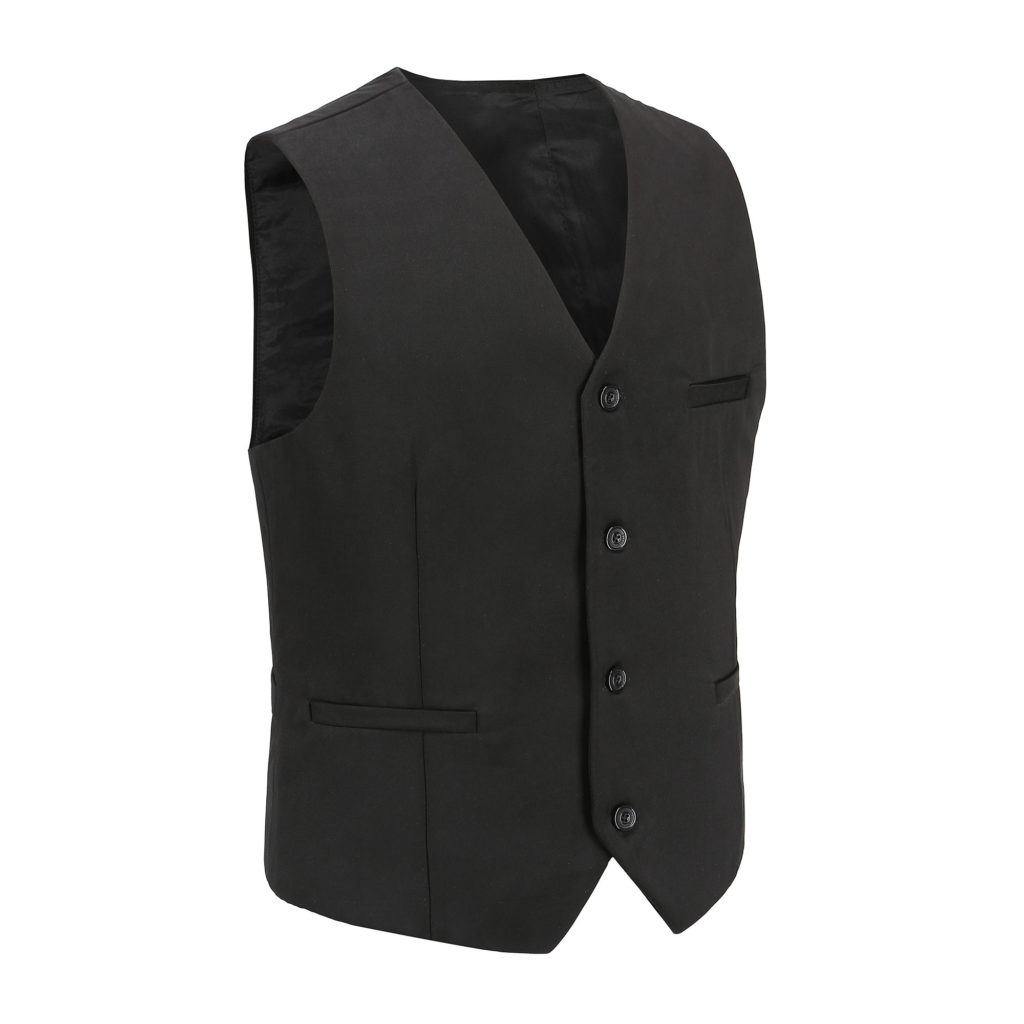
Final buying checklist and Before you trust a protective-clothing label, ask what the finished garment was actually tested to do.
Before you buy, save these five questions:
1.What protection is claimed? Separate cut, puncture and penetration claims.
2.What test method supports it? Get the method and edition, not just a rating.
3.Does the evidence apply to this garment? Confirm the exact model and whether the finished item was tested.
4.What areas are covered? Check the garment map, panels and untested areas.
5.What limitations and care requirements apply? Read them before relying on the product.
Cut-resistant and stab-resistant clothing are not interchangeable categories. A cut test answers a question about cutting under its defined conditions; a penetration test addresses a different hazard. The useful evidence is specific, traceable and limited to what the method actually assessed.
If a claim is unclear, ask the retailer before buying. If you are selecting workwear, use the workplace risk assessment and competent advice rather than treating clothing as a complete control measure. And if you cannot verify that the evidence applies to the product you are considering, do not assume that a similar-sounding material or label fills the gap.
Learn what to look for before you buy: start with the existing StabApparel testing-guidelines page. Then compare the exact documentation with the questions in this guide. The purpose is informed research—not fear, urgency or a promise of protection.