The Best Buyer’s Guide to Stab-Resistant Shirts, Hoodies, Vests & Protective Workwear

Undetectable Knives and Blades
Introduction Stab-Proof Clothing : Protective Workwear Work Clothing and Work Uniforms
For a growing number of professionals across security, healthcare, retail, transport, and frontline public services, the question of personal protection against sharp-object threats has shifted from an abstract concern to a practical procurement consideration. The reasons are varied: heightened awareness of workplace violence, evolving risk assessments in customer-facing roles, and a broader recognition that protective clothing no longer needs to look like body armour to provide meaningful resistance.
Stab-resistant clothing has evolved considerably. What was once bulky, overt, and uncomfortable has, in many cases, become discreet enough to wear as an everyday garment. A stab-resistant T-shirt can now sit under a uniform shirt without drawing attention. A protective polo can pass for standard corporate workwear. This shift has opened up protective clothing to new categories of workers who might previously have dismissed it as impractical or intimidating.
But this evolution has also created confusion. The market is filled with terminology that overlaps, contradicts, or overpromises. “Stab-proof,” “stab-resistant,” “cut-resistant,” “knife-resistant,” “anti-slash,” “puncture-proof”—these phrases are often used interchangeably in marketing, yet they describe different performance characteristics. A garment that performs well against a slash may offer limited resistance to a thrust. A cut-resistant glove is not automatically a stab-resistant vest. Understanding these distinctions is not pedantic; it is the difference between purchasing protection that meets a genuine risk and purchasing a false sense of security.
This guide is written for buyers in 2027 who need to make informed decisions—whether they are an individual seeking discreet everyday protection or an organisation equipping a team of frontline staff. It will explain how stab-resistant clothing works, what the relevant standards actually measure, how to evaluate materials like UHMWPE and aramid fibres, and what protective clothing can and cannot do. It will also provide practical guidance on choosing between garment types and considerations for bulk procurement.
StabApparel exists to serve this market: individuals and organisations seeking discreet, lightweight protective clothing designed to provide resistance against knife and sharp-object threats. Throughout this guide, we will reference the StabApparel range where it is genuinely relevant to the decisions you are making—not as a relentless sales pitch, but as a practical illustration of how different garments suit different needs.
By the end of this article, you should have a clear framework for evaluating stab-resistant clothing, a realistic understanding of its capabilities and limitations, and a sense of which garment type—or combination of types—might suit your circumstances.
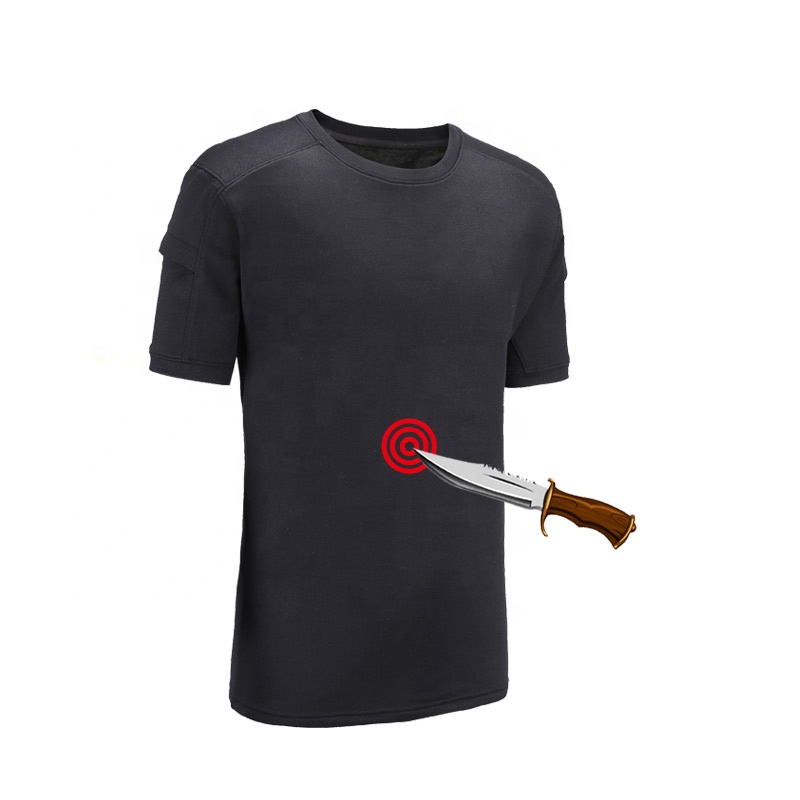
Stab Proof T-shirt
What Is Stab-Proof Clothing?
Stab-proof clothing is protective apparel designed to resist penetration from sharp objects, particularly knives and other pointed or edged weapons. In practice, the term “stab-proof” is widely used in marketing but is technically imprecise. A more accurate description is stab-resistant clothing—garments engineered to reduce the likelihood or depth of penetration under specified test conditions, but which cannot guarantee absolute protection against every threat, angle, or force.
The distinction matters. No garment can be legitimately described as “proof” against all stabbing scenarios because real-world attacks vary enormously in weapon type, force, angle, and point of impact. A knife that slides off a protective panel at one angle might find a seam at another. A garment tested to a particular standard may perform well under those test conditions but differently in uncontrolled circumstances.
What stab-resistant clothing can do is provide a measurable, tested level of resistance that reduces risk. It does this through the use of high-strength fibres and carefully constructed panel systems that absorb and dissipate the energy of a thrust or slash.
Knife-resistant clothing is a broader category that includes both stab resistance (protection against thrusting or puncturing) and cut resistance (protection against slicing or slashing). Many garments offer some degree of both, but the performance characteristics are different and should not be assumed to be equivalent.
When evaluating stab-resistant clothing, the key question is not “is this stab-proof?” but rather: “What specific threats has this garment been tested against, to what standard, and what were the results?” Any manufacturer or retailer that cannot answer those questions clearly should be treated with caution.
How Does Stab-Resistant Clothing Work?
Stab-resistant clothing works by interposing layers of high-strength material between a sharp object and the wearer’s body. When a knife or spike strikes the garment, the protective layers absorb and redistribute the energy of the impact, preventing the point from penetrating deeply enough to cause serious injury.
At a high level, there are two primary mechanisms:
Energy absorption through fibre strength and elongation. High-performance fibres such as UHMWPE (ultra-high-molecular-weight polyethylene) and aramid fibres possess exceptional tensile strength. When a blade presses against a woven or laminated structure made from these fibres, the load is distributed across many individual filaments. The fibres stretch slightly and absorb energy, reducing the force concentrated at the point of the blade.
Penetration resistance through structure and density. The way protective fibres are arranged—whether woven, laminated, or combined with rigid or semi-rigid elements—affects how well the material resists a pointed object being driven through it. Dense, tightly constructed layers create a more effective barrier against penetration than loosely woven fabrics.
Garment construction matters as much as the material itself. A protective panel that covers the vital organs but leaves gaps at the sides or shoulders provides incomplete coverage. Seams, zips, and other fastenings can create weak points if not designed with protection in mind. The fit of the garment also affects performance: a panel that shifts during movement may not be in the right position when it is needed.
This is why reputable manufacturers invest not only in high-quality materials but in garment design that keeps protection in the right place, maintains comfort during wear, and integrates protection without compromising mobility.
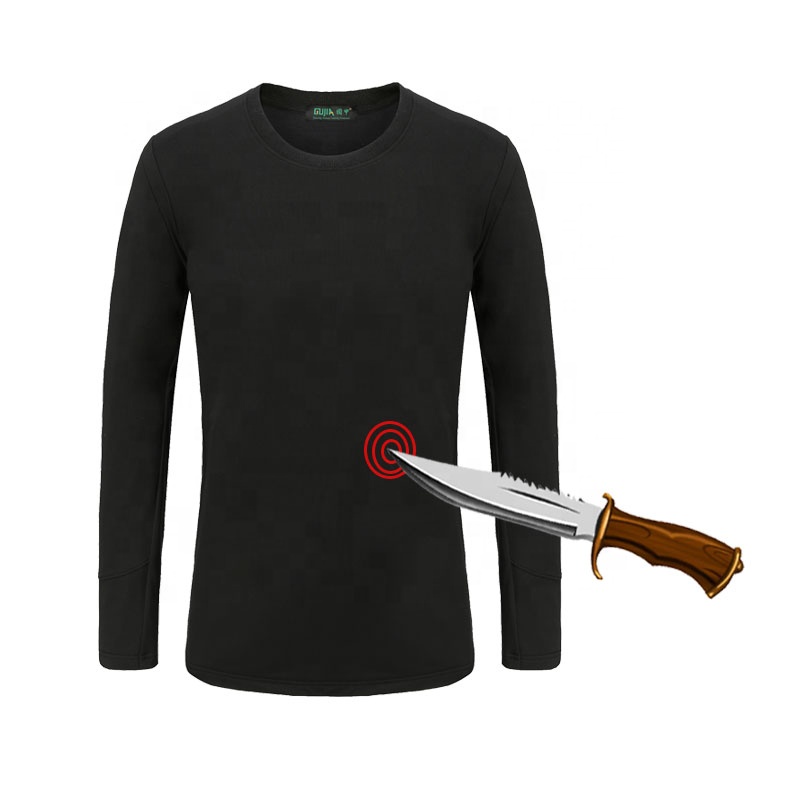
Full Protection stab proof Long Sleeve Shirt
Stab Resistance vs Cut Resistance
One of the most common and potentially dangerous misunderstandings in protective clothing is the assumption that “cut-resistant” and “stab-resistant” mean the same thing. They do not. They describe protection against fundamentally different threat mechanics.
Cut resistance refers to a material’s ability to resist being sliced or slashed. The threat is a blade moving laterally across the surface of the garment. Cut-resistant materials are typically evaluated using tests that measure how much force is required to cut through the material with a blade under controlled conditions.
Stab resistance refers to a material’s ability to resist being penetrated by a pointed object driven directly into it. The threat is a thrust or puncture, with the force concentrated at a single point. Stab-resistant materials are tested by driving a standardised spike or blade into the material at a specified energy level and measuring the depth of penetration.
A garment that performs well against a slash may offer limited resistance to a thrust, and vice versa. This is why the distinction matters. A cut-resistant sleeve designed for glass handling is not a stab-resistant vest. A stab-resistant panel may not provide the same level of cut protection across its surface.
Slashing involves a sweeping or diagonal motion, typically targeting the face, neck, or arms. Stabbing involves a direct thrust, often targeting the torso. Puncturing can involve any pointed object—a needle, a spike, a sharpened tool—driven through the material.
The practical implication for buyers is straightforward: identify the threat you are protecting against, then look for garments that have been tested against that specific threat. Do not assume that one type of resistance implies the other.
Understanding the Materials Used in Protective Clothing
UHMWPE (Ultra-High-Molecular-Weight Polyethylene)
UHMWPE is a type of polyethylene with extremely long molecular chains, typically with a molecular mass of several million atomic mass units . This structure gives the material exceptional strength-to-weight ratio—it is, weight for weight, significantly stronger than steel.
In protective clothing, UHMWPE is used in the form of high-performance fibres, often woven or laminated into protective panels. The fibres are lightweight, flexible, and resistant to moisture and many chemicals. Research has shown that UHMWPE can outperform other common protective fibres in certain ballistic and impact scenarios .
Advantages:
- High strength-to-weight ratio
- Good flexibility
- Moisture resistant
- Can be constructed into relatively thin, discreet panels
Limitations:
- Performance can degrade at elevated temperatures
- Not inherently resistant to all threat types
- Like all materials, the final performance depends on garment construction
Kevlar and Aramid Fibres
Kevlar is a brand name for a type of aramid fibre developed by DuPont. Aramid fibres are characterised by high strength, high modulus (stiffness), and good thermal stability. Kevlar is widely used in protective applications including body armour, cut-resistant gloves, and stab-resistant panels.
Aramid fibres work by absorbing energy through a combination of high tensile strength and moderate elongation. When a blade strikes a Kevlar panel, the fibres stretch and distribute the load, reducing the force at the point of impact.
Advantages:
- Well-established in protective applications
- Good thermal stability
- Effective in cut-resistant constructions
Limitations:
- Can degrade over time, particularly with exposure to moisture and UV light
- Generally heavier than UHMWPE for equivalent protection
- Performance varies significantly depending on weave and construction
Other Protective Materials
Other materials used in stab- and cut-resistant clothing include:
- Polyester and nylon in engineered weaves, sometimes combined with high-performance fibres
- Composite materials incorporating rigid or semi-rigid elements for specific applications
- Carbon fibre composites used in some vest panels
Each material has its own profile of strengths and limitations. The best garment for a given application depends on the specific threat, the required coverage, comfort considerations, and the environment in which it will be worn.
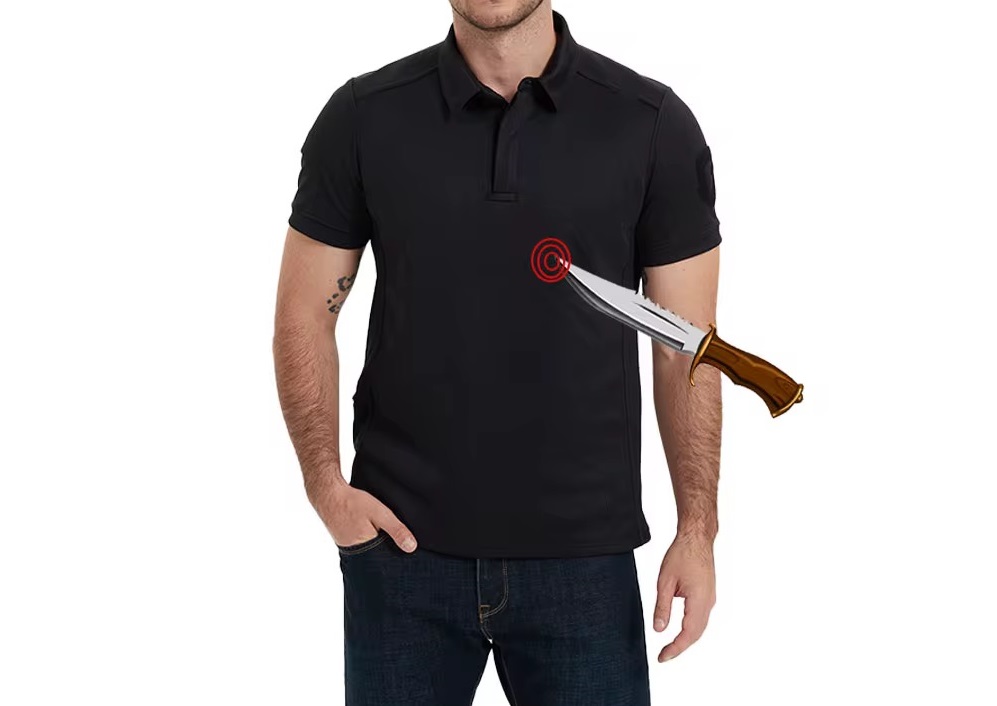
Stab proof Polo shirt
Understanding EN388 and Protective Clothing Standards
EN388 is a European standard that specifies requirements and test methods for protective gloves against mechanical risks . It is one of the most commonly referenced standards in the protective clothing industry, and understanding what it does—and does not—measure is essential for informed buying.
The standard evaluates performance across several categories:
Abrasion resistance (a): Measures how well the material withstands rubbing and wear.
Blade cut resistance (b): The “Coupe test,” which measures resistance to a rotating circular blade under specified conditions. Rated on a scale of 1 to 5, with higher numbers indicating greater resistance .
Tear resistance (c): Measures the force required to tear the material.
Puncture resistance (d): Measures the force required to penetrate the material with a pointed tip. Rated on a scale of 1 to 4, with levels corresponding to 20, 60, 100, and 150 Newtons .
EN ISO Cut Resistance (e): A newer test method (TDM test) introduced because the Coupe test could produce inaccurate results with certain high-performance materials. Rated A to F, with F being the highest level .
Impact protection (f): Assessed where applicable.
The Critical Distinction
EN388 is a standard for protective gloves. Its test methods may be applicable to arm protectors, but it is not a standard for stab-resistant body armour or stab-resistant clothing in general .
More importantly, a high EN388 puncture resistance rating does not mean a garment is stab-resistant. The puncture test in EN388 uses a standardised probe under controlled conditions. A knife thrust involves different forces, angles, and blade geometries. A material that scores well on the EN388 puncture test may still be vulnerable to certain types of stabbing attacks.
For stab resistance specifically, the relevant standards are different. The US National Institute of Justice (NIJ) Standard 0115.00 is widely referenced, setting a maximum penetration depth of 7mm for spikes or stabs applied perpendicularly to protective material . Some manufacturers also reference the UK Home Office CAST (Combined Assault Standards for Test) knife resistance standard, such as KR1 .
When evaluating stab-resistant clothing, look for evidence that the garment has been tested to a stab-specific standard, not just a general mechanical protection standard.
How to Evaluate Stab-Resistant Clothing in 2027
Purchasing protective clothing is a risk-management decision. The following checklist provides a structured way to evaluate options.
Testing and standards
- Has the garment been tested to a recognised stab-resistance standard (e.g., NIJ 0115.00, CAST KR1)?
- What energy level was used in testing?
- What penetration depth was recorded?
- Is the test documentation available?
Materials
- What protective fibres are used (UHMWPE, aramid, other)?
- How are they constructed (woven, laminated, composite)?
- What is the weight of the protective panel?
Coverage
- Which areas of the body does the garment protect?
- Are the sides, shoulders, and back covered?
- Do seams and fastenings create weak points?
Fit and comfort
- Does the garment fit correctly without being restrictive?
- Can it be worn for extended periods?
- Does it allow necessary mobility?
Breathability and weight
- How heavy is the garment?
- Does it manage moisture and heat effectively?
- Is it suitable for the climate and working conditions?
Durability and care
- What are the washing instructions?
- Can the protective panels be removed for cleaning?
- What is the expected lifespan?
Appearance
- Is the garment discreet enough for the intended use?
- Does it integrate with existing uniforms or workwear?
Manufacturer credibility
- Can the manufacturer provide test documentation?
- Do they make clear, measured claims about performance?
- Do they explain limitations honestly?
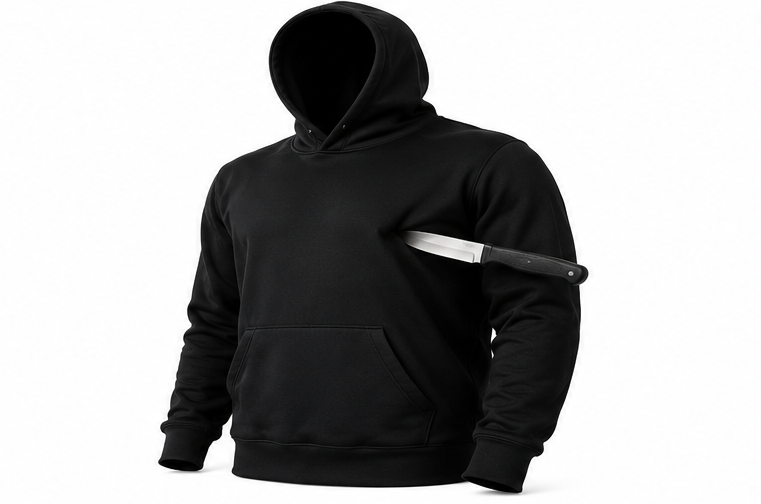
Stabapparel Stabproof Hoodie
How Much Does Stab-Resistant Clothing Cost?
Stab-resistant clothing prices vary widely, reflecting differences in materials, construction, testing, coverage, and intended market. It is not possible to provide accurate competitor pricing, and prices change over time. What matters more than a specific figure is understanding why prices differ and what you are paying for.
Material costs are a significant factor. High-performance fibres like UHMWPE and aramid are more expensive than standard textiles. The quantity of protective material in a garment—a full-coverage vest versus a T-shirt with limited panel coverage—directly affects cost.
Construction complexity matters. Garments that integrate protective panels discreetly, maintain comfort, and ensure the panels stay in position during movement require more design and manufacturing effort than simple products.
Testing and certification add cost. A manufacturer that invests in independent testing to recognised standards is providing documentation that supports their performance claims. That testing is not free.
Coverage and protection level affect price. A garment protecting the full torso against higher energy threats will cost more than a garment with lighter, more limited protection.
Professional and B2B requirements may add cost through customisation, sizing ranges, branding, and procurement processes.
For StabApparel pricing, please refer to the individual product pages on stabapparel.com, where current prices are listed. The key point is that protective clothing should be evaluated on the basis of the protection it provides relative to the risk you are managing—not simply on price alone. The cheapest option is not necessarily the best value if it does not provide the coverage or performance you need.
Stab-Proof T-Shirts
Stab-resistant T-shirts represent one of the most discreet forms of protective clothing. Designed to be worn as an undergarment or as a standalone top in casual settings, they allow protection to be integrated into everyday dress without drawing attention.
Who might consider them:
- Individuals who want discreet everyday protection
- Professionals who cannot wear overt protective gear but face elevated risk
- Anyone seeking a lightweight base layer with protective properties
Advantages:
- Highly discreet—can be worn under a regular shirt
- Lightweight and relatively comfortable
- Suitable for everyday wear
- Does not alter outer appearance
Considerations:
- Coverage is typically focused on the torso
- Protection level depends on the specific panel construction
- Layering may affect breathability
StabApparel offers a range of stab-resistant T-shirts designed for discreet, lightweight protection. These garments are intended to provide resistance to knife and sharp-object threats while remaining comfortable enough for daily wear.
View the StabApparel stab-resistant T-shirt range.
Stab-Proof Long-Sleeve Shirts
Long-sleeve protective shirts extend coverage to the arms, which can be relevant in environments where slash or cut threats are a concern alongside stab risks.
Coverage: Protection typically extends across the torso and along the arms. The specific coverage depends on the garment design.
Professional environments: Long-sleeve shirts are common in security, industrial, and outdoor work settings. A protective long-sleeve shirt can integrate into these environments without appearing out of place.
Layering: These garments work well as a base layer or as a standalone shirt in cooler conditions.
Workplace use: Where workplace dress codes require covered arms, a protective long-sleeve shirt can meet uniform standards while adding protection.
Explore StabApparel’s stab-resistant long-sleeve shirts.
Stab-Proof Hoodies
Protective hoodies combine casual, familiar styling with protective functionality. They are particularly relevant for outdoor workers, cooler climates, and environments where a hoodie would not look out of place.
Casual appearance: A hoodie draws less attention than overt protective gear. In many workplaces and social settings, it reads as ordinary clothing.
Outdoor work: For security patrols, delivery drivers, and outdoor staff in cooler conditions, a protective hoodie provides both warmth and protection.
Layering: Hoodies can be worn over a protective T-shirt for additional coverage or as a standalone garment.
Comfort: Modern protective hoodies are designed to be worn for extended periods without excessive weight or restriction.
See StabApparel’s stab-resistant hoodies.
Stab-Proof Polo Shirts
Polo shirts occupy a useful middle ground: more formal than a T-shirt, more casual than a dress shirt, and widely accepted as standard workwear in many industries.
Professional appearance: A protective polo can be worn as part of a uniform in security, retail, hospitality, and corporate environments without looking like protective equipment.
Customer-facing workers: For staff who interact with the public, a polo shirt presents a professional image while providing discreet protection.
Uniform environments: Polos are easy to brand and integrate into existing uniform programmes.
Security, retail, and hospitality: These sectors often have dress codes that a protective polo can satisfy while adding a layer of protection.
View StabApparel’s protective polo shirts.
Stab-Proof Vests and Stab Proof Waistcoats
Protective vests and protective waistcoats provide an additional layer of coverage, often over the torso and sometimes extending to the sides.
Additional protective layers: A vest can be worn over a shirt or T-shirt for increased protection in higher-risk situations.
Coverage: Vests typically protect the vital organs—heart, lungs, liver, kidneys—and may extend to cover more of the torso than a T-shirt panel.
Layering: Vests can be worn as an outer layer in warm conditions or as a mid-layer under a jacket in cooler weather.
Professional use: Overt or covert vests are common in security, law enforcement support, and other roles where visible or discreet protection is appropriate.
Advantages and considerations: Vests provide substantial protection but are generally more visible than a T-shirt or polo. The choice between overt and covert depends on the role and the environment.
Explore StabApparel’s protective waistcoats and vests.
Protective Workwear for Professional Teams
For organisations, protective clothing is not just a product—it is part of a broader safety strategy. The considerations differ from individual purchasing because they involve multiple wearers, consistency, procurement processes, and integration with existing uniforms and procedures.
Security Professionals
Security work encompasses a wide range of environments and risk levels, from retail security to door supervision to corporate site protection. Requirements vary accordingly. Garments that look professional, allow mobility, and provide discreet or visible protection depending on the role are typically most suitable.
Healthcare Workers
Healthcare staff, particularly those in emergency departments, mental health facilities, and community roles, may face elevated risk of aggression. Protective clothing for healthcare must be compatible with clinical environments—easy to clean, comfortable for long shifts, and not disruptive to patient care.
Retail Employees
Retail workers in certain settings—late-night convenience stores, high-value goods, or areas with elevated crime rates—may face risk of robbery or assault. Discreet protection that does not alarm customers or disrupt the shopping environment is often preferred.
Transport Workers
Bus drivers, train staff, and transport enforcement officers can encounter aggression. Protective clothing that integrates with uniform requirements and allows for the mobility needed in transport roles is important.
Delivery Workers
Delivery drivers, particularly those working alone in unfamiliar areas, may face risk. Lightweight, discreet protection that does not impede movement or draw attention is valuable.
Education Professionals
Staff in schools and colleges may face risk in certain circumstances. Protective clothing for education settings must be discreet and compatible with a professional, approachable appearance.
Event Security
Event security staff may face elevated risk in crowded, emotionally charged environments. Protective clothing that is comfortable for long shifts, allows mobility, and presents an authoritative but not intimidating appearance is often appropriate.
Frontline Workers and Customer-Facing Staff
Across many sectors, frontline staff who interact directly with the public may face elevated risk. The common requirements are comfort, discretion, and integration with existing workwear.
StabApparel’s protective workwear range is designed to meet these varied needs with discreet, lightweight garments that can be worn as part of professional uniforms.
Individual Protection vs Corporate Protective Workwear
The considerations for individual buyers and organisations differ significantly.
Individual Buyers
Individuals typically prioritise:
- Discretion (can it be worn under or as everyday clothing?)
- Comfort (will I actually wear it?)
- Ease of purchase (no complex procurement)
- Clear information about protection levels
Organisations
Organisations must consider:
- Number of employees requiring protection
- Consistent sizing across a workforce
- Procurement processes and budgeting
- Product selection appropriate to different roles
- Uniform integration and branding
- Replacement requirements and durability
- Staff comfort and acceptance
- Communication and training about use and limitations
For organisations, protective clothing is a programme, not a one-off purchase. Consistency, durability, and staff buy-in matter as much as the technical specifications of individual garments.
If you are equipping a team, StabApparel can discuss protective workwear requirements and bulk purchasing. Contact StabApparel to discuss your organisation’s needs.
How to Choose the Right Stab-Resistant Garment
| Requirement | Garment to consider |
|---|---|
| Discreet everyday wear | Protective T-shirt |
| Long-sleeve coverage | Protective long-sleeve shirt |
| Cooler weather / casual settings | Protective hoodie |
| Professional uniform | Protective polo |
| Additional protective layer | Protective vest/waistcoat |
| Team requirements | Protective workwear |
The appropriate choice depends on the specific context: the working environment, dress requirements, climate, level of risk, and personal preference. A T-shirt might be ideal for discreet everyday wear but insufficient for a role requiring full torso coverage. A vest might provide more protection but be unsuitable for a covert role. There is no universally “best” garment—only the most suitable garment for a given set of circumstances.
Stab-Proof Clothing for Different Industries
Security
Security professionals operate across diverse environments and risk levels. Door supervisors, retail security, corporate security, and event security all have different requirements. Garments that look professional, allow freedom of movement, and provide appropriate protection for the role are key. Discreet options suit roles where an overt security presence is not desirable; overt options may be appropriate where visible deterrence is part of the role.
Relevant StabApparel products: protective polos, vests, and T-shirts.
Healthcare
Healthcare workers in emergency, mental health, and community settings may face risk. Comfort for long shifts, ease of cleaning, and compatibility with clinical work are essential. Discretion is often important to avoid alarming patients.
Relevant StabApparel products: discreet T-shirts and lightweight vests that can be worn under scrubs or uniforms.
Retail
Retail staff in late-night or high-risk settings may benefit from discreet protection. Garments that look like ordinary workwear and do not disrupt the customer experience are most suitable.
Relevant StabApparel products: T-shirts, polos, and discreet vests.
Transport
Transport workers need mobility and comfort for long shifts. Protection should not impede driving or moving through vehicles and stations.
Relevant StabApparel products: lightweight T-shirts, long-sleeve shirts, and vests.
Delivery
Delivery drivers often work alone and may enter unfamiliar areas. Discreet, comfortable protection that can be worn all day is valuable.
Relevant StabApparel products: T-shirts and hoodies.
Education
School and college staff need protection that is discreet and does not undermine their professional, approachable role.
Relevant StabApparel products: discreet T-shirts and polos.
Events
Event security and staff face crowded, sometimes volatile environments. Comfort, mobility, and appropriate visible or discreet protection are all considerations.
Relevant StabApparel products: polos, vests, and workwear suitable for team deployment.
Hospitality
Hospitality staff in late-night venues may face risk. Protection should be discreet and compatible with a welcoming professional appearance.
Relevant StabApparel products: T-shirts and polos.
Frontline Customer Service
Staff in housing offices, benefit centres, and similar settings may face aggression. Protection that is discreet and comfortable for desk-based work is appropriate.
Relevant StabApparel products: T-shirts, polos, and lightweight vests.
Is Stab-Resistant Clothing Comfortable?
Comfort is not a luxury in protective clothing—it is a functional requirement. A garment that is uncomfortable will not be worn consistently, and protection that is not worn provides no benefit.
Modern stab-resistant clothing has advanced considerably in comfort. Key factors include:
Weight: Protective panels add weight, but modern materials allow relatively lightweight construction. The weight should be appropriate for the level of protection.
Breathability: Heat and moisture management are critical for long shifts. Garments that trap heat become unbearable in warm environments or during physical activity.
Flexibility: The garment should allow the movement required for the role—reaching, bending, driving, and so on.
Fit: A correct fit ensures the protective panels stay in position and do not restrict movement.
Layering: The ability to layer garments—a T-shirt under a polo, a vest over a shirt—allows adaptation to different conditions.
Fabric and design: The outer fabric and overall design affect how the garment feels and looks.
Mobility: Protection should not come at the cost of the ability to do the job.
For organisations, staff comfort directly affects compliance. If employees find protective clothing uncomfortable, they are less likely to wear it correctly, undermining the entire protection programme.
How Should Stab-Resistant Clothing Fit?
Correct fit is essential for both comfort and protection.
Sizing: Follow the manufacturer’s sizing guidance. Protective garments are designed to fit in specific ways, and sizing that is too tight or too loose can compromise performance.
Coverage: The garment should provide the intended coverage without gaps. A vest that rides up or a T-shirt that shifts can leave areas unprotected.
Mobility: You should be able to move naturally—reach, bend, and perform work tasks—without the garment restricting you or shifting out of position.
Layering: If the garment will be worn under or over other clothing, consider how the layers interact. Too many tight layers can restrict movement; too loose can cause the protective panel to shift.
Avoid excessive looseness: A garment that is too loose may allow the protective panel to move away from the body, reducing effectiveness.
Follow manufacturer sizing information: StabApparel provides sizing guidance for its products. Check the StabApparel size guide for specific measurements and fit recommendations.
How to Wash and Maintain Stab-Resistant Clothing
Care instructions vary by product. Always follow the specific care label and manufacturer guidance for your garment.
General principles:
- Follow care labels: The manufacturer’s instructions are designed to maintain the performance of the protective materials.
- Washing: Some garments allow the protective panels to be removed for washing of the outer cover. Others may be washable as a complete unit. Check the specific product instructions.
- Drying: Follow recommended drying methods. High heat can damage some protective fibres.
- Storage: Store clean and dry. Avoid compressing protective panels excessively.
- Inspection: Regularly inspect for damage—tears, punctures, worn areas, or deterioration of the protective material.
- Signs of damage: Any visible damage to protective panels should be assessed. Damaged protection may not perform as intended.
- Replacement: Follow manufacturer guidance on lifespan and replacement. Protective materials can degrade over time with use and washing.
Do not invent or assume washing instructions. Always refer to the specific product documentation.
How Long Does Stab-Resistant Clothing Last?
The lifespan of stab-resistant clothing depends on multiple factors:
- Frequency of use: Daily wear will naturally cause more wear than occasional use.
- Washing: Repeated washing, especially if not done according to instructions, can affect protective materials.
- Wear and tear: Physical damage, abrasion, and exposure to chemicals or UV light can degrade performance.
- Storage: Improper storage can damage protective panels.
- Construction quality: Well-constructed garments generally last longer.
- Manufacturer instructions: Follow guidance on care and replacement.
There is no universal lifespan. Some manufacturers provide guidance; others may not. If in doubt, inspect the garment regularly and replace it if there are signs of damage or deterioration that could affect performance.
Common Mistakes People Make When Buying Protective Clothing
Choosing solely on price: The cheapest option may not provide the protection you need. Evaluate the protection characteristics relative to your risk.
Assuming “cut-resistant” means “stab-resistant”: These are different threats. A cut-resistant garment is not automatically stab-resistant.
Ignoring testing and standards: Ask what the garment has been tested against and to what standard. “Tested” without specifics is not meaningful.
Ignoring coverage: A garment that protects the chest but not the sides may leave gaps. Consider the areas at risk.
Buying the wrong size: Ill-fitting protective clothing may not stay in position or may restrict movement.
Ignoring comfort: Protection that is not worn provides no benefit. Comfort is a functional requirement.
Assuming all protective materials perform identically: UHMWPE, aramid, and other materials have different characteristics. Construction matters as much as material.
Ignoring manufacturer instructions: Care and maintenance affect performance and lifespan.
Assuming protective clothing eliminates risk: No garment makes you invulnerable. Protective clothing is one part of a broader safety approach.
Choosing a garment unsuitable for the workplace: Appearance, integration with uniforms, and practicality matter. A garment that cannot be worn in your environment is not useful.
Stab-Proof Clothing vs Traditional PPE
Protective clothing and traditional PPE (personal protective equipment) share the goal of reducing risk, but they differ in important ways.
Purpose: Traditional PPE (helmets, gloves, eye protection) protects against specific hazards in defined work environments. Stab-resistant clothing addresses a different threat profile—sharp-object violence.
Coverage: PPE is often focused on specific body parts (head, hands, eyes). Protective clothing covers the torso and sometimes limbs.
Workplace integration: Protective clothing is designed to be worn as part of everyday workwear, often discreetly. Traditional PPE is typically visible and task-specific.
Appearance: Stab-resistant clothing can look like ordinary clothing. PPE is recognisable as safety equipment.
Comfort: Modern protective clothing prioritises comfort for extended wear. PPE comfort varies by type.
Appropriate use: Protective clothing does not replace other workplace safety measures, procedures, or training. It is one layer of protection within a broader risk-management approach.
Stab-Proof Clothing Buyer’s Checklist
Use this checklist when evaluating stab-resistant clothing:
- ☐ Intended use: What is the context? Work, everyday wear, specific role?
- ☐ Threat type: Stab, slash, or both?
- ☐ Relevant standard/testing: Has the garment been tested to a recognised stab-resistance standard?
- ☐ Coverage: Which body areas are protected?
- ☐ Material: What protective fibres and construction are used?
- ☐ Fit: Does it fit correctly and stay in position?
- ☐ Comfort: Can it be worn for the required duration?
- ☐ Mobility: Does it allow necessary movement?
- ☐ Breathability: Is it suitable for the climate and activity level?
- ☐ Washing requirements: Can it be maintained according to instructions?
- ☐ Durability: What is the expected lifespan and replacement guidance?
- ☐ Warranty: What does the manufacturer offer?
- ☐ Price: Does it represent value relative to protection and needs?
- ☐ Manufacturer information: Is the manufacturer clear about performance and limitations?
- ☐ Product documentation: Is test documentation available?
StabApparel Product Comparison
The following table is based on information available from StabApparel. For specific specifications, test information, and current pricing, please refer to the individual product pages.
| Product Category | Garment Type | Intended Use | Coverage | Key Features | Price |
|---|---|---|---|---|---|
| Stab-Resistant T-Shirt | T-shirt | Discreet everyday protection | Torso | Lightweight, discreet, everyday wear | Check product page |
| Stab-Resistant Long-Sleeve Shirt | Long-sleeve shirt | Discreet protection with arm coverage | Torso and arms | Layering, professional environments | Check product page |
| Stab-Resistant Hoodie | Hoodie | Cooler weather, casual settings | Torso | Warmth, discreet, casual appearance | Check product page |
| Stab-Resistant Polo Shirt | Polo | Professional uniform environments | Torso | Professional appearance, uniform integration | Check product page |
| Stab-Resistant Vest/Waistcoat | Vest | Additional protective layer | Torso (extended) | Additional coverage, layering | Check product page |
| Protective Workwear | Range | Professional/team deployment | Varies | Bulk options, uniform integration | Contact for details |
For current specifications, test information, and pricing, please visit the individual product pages on StabApparel.com.

Cut Resistant Waistcoat
Which StabApparel Product Is Right for You?
Choose a T-shirt if…
You want discreet, everyday protection that can be worn under or as a regular T-shirt. Ideal for individuals who need protection without changing their appearance.
Choose a long-sleeve shirt if…
You need arm coverage alongside torso protection, or work in environments where long sleeves are required.
Choose a hoodie if…
You want warmth and protection in a casual garment suitable for cooler conditions and outdoor work.
Choose a polo if…
You need protective clothing that meets professional uniform standards while providing discreet protection.
Choose a vest/waistcoat if…
You require additional protective coverage over a shirt or T-shirt, or need a garment that can be worn as an outer layer.
Contact StabApparel about protective workwear if…
You are equipping a team or organisation and need consistent protection across multiple wearers, with considerations for sizing, uniform integration, and procurement.
Frequently Asked Questions
What is stab-proof clothing?
Stab-proof clothing is protective apparel designed to resist penetration from sharp objects like knives. The more accurate term is “stab-resistant,” as no garment can guarantee absolute protection against every threat.
Is stab-proof clothing really stab proof?
No garment can honestly claim to be completely “stab-proof” against all threats. “Stab-resistant” is more accurate—it indicates tested resistance under specified conditions, not invulnerability.
What is the difference between stab-resistant and cut-resistant clothing?
Stab resistance protects against thrusting or puncturing. Cut resistance protects against slicing or slashing. They are different threat mechanics and require different testing and materials.
What is the best material for stab-resistant clothing?
UHMWPE and aramid fibres (like Kevlar) are commonly used. Both offer high strength-to-weight ratios. Construction and testing matter as much as the base material.
Is UHMWPE stronger than Kevlar?
UHMWPE generally has a higher strength-to-weight ratio than Kevlar. Research has shown UHMWPE outperforming Kevlar in certain ballistic and impact tests .
Is stab-resistant clothing comfortable?
Modern stab-resistant clothing is designed for comfort, with lightweight materials and breathable constructions. Comfort varies by product and should be a key consideration.
Can you wear stab-resistant clothing every day?
Yes. T-shirts, polos, and similar garments are designed for daily wear.
Can stab-resistant clothing be worn under normal clothes?
Discreet options like T-shirts and vests are designed to be worn under regular clothing.
Is stab-resistant clothing suitable for security guards?
Yes. Security professionals are among the primary users of stab-resistant clothing.
Is it suitable for healthcare workers?
Yes, particularly in emergency, mental health, and community settings where risk may be elevated.
Is it suitable for retail workers?
Yes, particularly in late-night or high-risk retail environments.
How much does stab-resistant clothing cost?
Prices vary widely based on materials, construction, coverage, and testing. Check StabApparel product pages for current pricing.
How should protective clothing fit?
It should fit correctly—snug enough to stay in position, loose enough for comfort and mobility. Follow manufacturer sizing guidance.
Can stab-resistant clothing be washed?
Many garments can be washed, sometimes with removable panels. Follow the specific care instructions for your product.
How long does protective clothing last?
Lifespan depends on use, washing, wear, and care. Follow manufacturer guidance and inspect regularly.
What does EN388 mean?
EN388 is a European standard for protective gloves against mechanical risks, testing abrasion, cut, tear, puncture, and impact resistance .
Does EN388 mean a shirt is stab proof?
No. EN388 is a glove standard. Its puncture test is not equivalent to stab-resistance testing. Look for stab-specific testing.
Does stab-resistant clothing protect against all knives?
No. Performance depends on weapon type, force, angle, and the specific garment. It provides tested resistance, not absolute protection.
Does protective clothing replace other workplace safety measures?
No. Protective clothing is one layer of protection within a broader safety approach that includes procedures, training, and environmental measures.
Can businesses buy protective workwear in bulk?
Yes. StabApparel offers protective workwear suitable for teams. Contact StabApparel to discuss bulk requirements.