
The Best Stab-Proof Jackets
Smart stab proof jackets
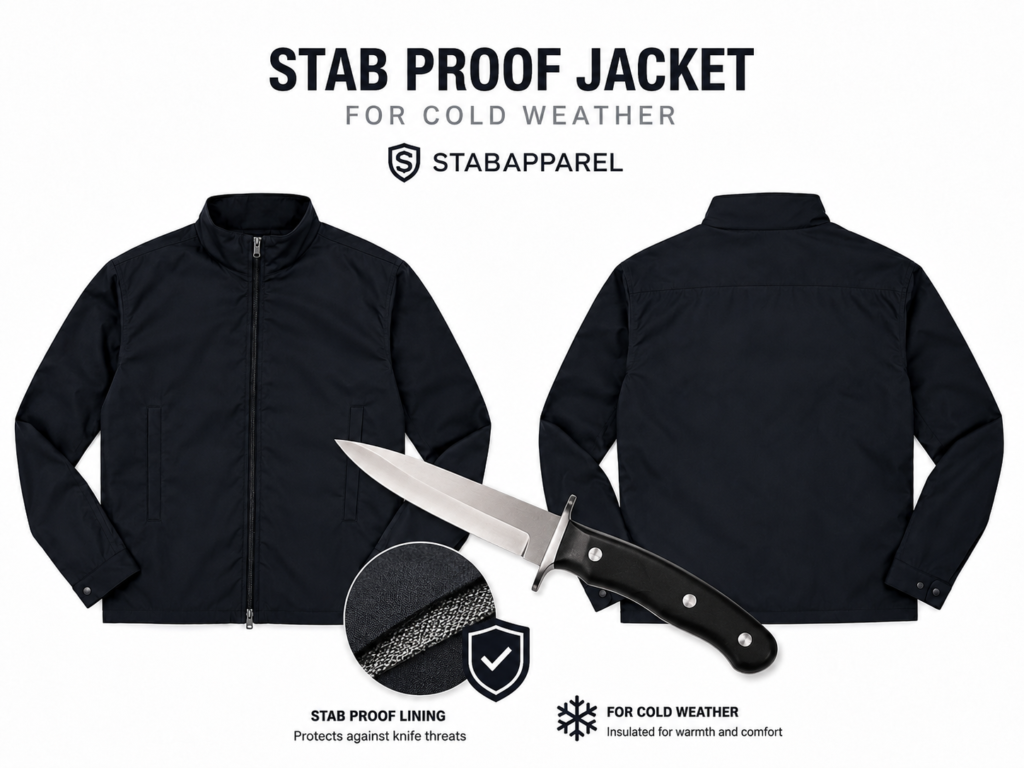
1. Introduction Smart Stabproof Jacket
A jacket can be part of a practical personal-safety plan without looking like protective equipment. For rideshare drivers, delivery workers, healthcare professionals, retail employees, security staff, commuters, and people working late hours, stab-resistant jackets offer a way to add a layer of protection while maintaining an ordinary appearance.
The growing interest in everyday protective apparel reflects a straightforward need: some people spend long hours in public-facing jobs or unfamiliar environments and want clothing that combines mobility, comfort, and a degree of tested protection. A conventional jacket may provide warmth and weather resistance, but it is not designed to resist knife penetration. Protective garments use specialized materials and construction to address that limitation.
The important distinction is that stab-resistant does not mean stab-proof. Protection depends on the materials, coverage, design, test method, and threat type. A garment tested against an edged blade may not offer equivalent protection against a pointed spike. Even a certified protective garment cannot eliminate injury risk, particularly outside its protected coverage area.
This guide examines what to look for in a knife-resistant jacket, how established testing standards work, and which purchasing criteria matter most when choosing everyday stab-resistant apparel. It also compares representative product categories, explains the limitations of manufacturer claims, and discusses comfort, maintenance, and US legal considerations.
For readers considering StabApparel, the brand’s current offer is 10% off with code [INSERT CODE], subject to confirmation of the code’s validity and applicable terms. Use [INSERT LINK] to access the offer or the relevant product page.
The goal is to make a responsible buying decision—not to encourage unnecessary fear or suggest that protective clothing makes dangerous situations safe. The most useful garment is one that fits properly, meets a clearly stated protection requirement, and can realistically be worn throughout a normal working day.
2. Quick Answer: Top Stab-Resistant Jackets for Everyday Use
The best stab-resistant jacket is one that combines independently documented protection, adequate coverage, and a comfortable fit with the wearer’s daily clothing requirements. There is no universal winner because a discreet commuter jacket and an overt professional protective garment serve different purposes.
Best overall buying approach: Choose a jacket or jacket-compatible armor system with documented testing against the specific threat you need protection from, preferably with an identifiable laboratory report and clearly defined coverage.
Best Overall Buying Criteria
A properly fitted, independently tested, knife-resistant garment with clearly documented protection
Prioritize verifiable performance, fit, and comfort over marketing language, appearance, or an unusually low advertised price.
Top 7 options to compare
The following shortlist represents relevant product categories and potential purchasing candidates. It is deliberately not presented as a laboratory-verified ranking: current product-specific testing, prices, weights, and availability must be confirmed before publication.
| Pick | Best for | Protection | Weight | Concealability | Price |
|---|---|---|---|---|---|
| StabApparel everyday jacket | Everyday wear | [VERIFY] | [VERIFY] | [VERIFY] | [VERIFY] |
| StabApparel concealed armor system | Discreet protection | [VERIFY] | [VERIFY] | [VERIFY] | [VERIFY] |
| StabApparel professional jacket | Workwear use | [VERIFY] | [VERIFY] | [VERIFY] | [VERIFY] |
| Covert stab-resistant vest with outer jacket | Layered clothing | Depends on panel | [VERIFY] | High potential | [VERIFY] |
| Overt professional stab vest | Security personnel | Depends on certification | [VERIFY] | Low | [VERIFY] |
| Custom-fit protective jacket | Specific sizing needs | [VERIFY] | [VERIFY] | [VERIFY] | [VERIFY] |
| Modular protective garment | Flexible coverage | Depends on configuration | [VERIFY] | [VERIFY] | [VERIFY] |
Important: A product’s inclusion in a shortlist does not establish that it meets NIJ Standard 0115.00 or any other protection standard. Do not substitute a product description, marketing photograph, or seller statement for a test report.
How to interpret these picks
- Everyday jacket: Prioritize a natural fit, practical pockets, suitable temperature management, and armor that does not interfere excessively with movement.
- Concealable armor system: Consider this when you want to wear ordinary outer clothing over protective panels.
- Professional jacket: Look for clear coverage information, documented performance, and compatibility with the demands of your job.
- Custom-fit garment: A potential solution for unusual proportions or long shifts, provided the protective construction remains within its tested configuration.
- Modular garment: Useful only when each component and the assembled configuration are appropriately documented.
StabApparel: what to verify before buying
StabApparel should be evaluated using the same evidence standards as any other protective-clothing brand.
Before naming a specific StabApparel model as a certified or best-performing product, verify:
- The exact model and version.
- The protection standard and level.
- Whether the test applies to the complete garment or removable panels.
- The laboratory name and report date.
- Whether the report covers edged blades, spikes, or both.
- The coverage area and protected zones.
- The garment’s weight and size-specific measurements.
- Its current price, warranty, and care instructions.
StabApparel offer: Eligible readers may receive 10% off with code [INSERT CODE] or through [INSERT LINK]. Confirm the code, exclusions, and offer expiration before publishing.
3. How Stab-Resistant Jackets Work
Stab-resistant jackets use engineered materials and protective construction to reduce the likelihood that a sharp instrument will penetrate the protected area. Their performance depends on material selection, layering, construction, coverage, and the testing method used to evaluate the finished armor.
What makes a jacket stab-resistant?
Ordinary clothing is generally designed for comfort, insulation, abrasion resistance, and weather protection. A protective garment adds a specialized component intended to resist penetration from specified sharp threats.
That component may be integrated into the jacket or supplied as a removable panel system. The outer garment can look like conventional clothing, but the protective insert or textile assembly is responsible for the tested resistance.
The distinction matters because a jacket’s fabric, lining, and armor panel are not necessarily equivalent in protective capability. A manufacturer might use the phrase “knife-resistant jacket” to describe a product whose resistance comes primarily from an insert covering only part of the torso.
A buyer should therefore ask three separate questions:
- What part of the garment provides protection?
- What type and level of protection has that component demonstrated?
- Which areas of the body are actually covered?
Materials used in stab-resistant clothing
Several material families appear in protective clothing. Each has advantages and limitations, and none should be treated as protective merely because its name appears in a product description.
High-density aramid fibers
Aramid fibers are synthetic materials known for high strength relative to weight and resistance to heat. They are used in various protective textiles, including some personal protective equipment.
Aramid-based structures can help distribute and resist forces through multiple layers. However, fiber identity alone does not determine a garment’s stab resistance. Weave, density, construction, layering, and the finished panel’s test results are more important than the material name by itself.
Ultra-high-molecular-weight polyethylene (UHMWPE)
UHMWPE is a high-performance polyethylene material used in lightweight protective applications.
Its high strength-to-weight characteristics can be useful when designers seek lower garment weight. As with aramid, the protective performance depends on the finished construction and intended threat, not simply on the presence of UHMWPE.
Some UHMWPE products are designed primarily for ballistic resistance. That does not automatically mean they resist knife or spike penetration.
Layered laminates
Layered laminates combine multiple sheets or textile structures into an engineered protective assembly.
The objective may be to improve penetration resistance while balancing flexibility, weight, and thickness. A laminate can be effective in a particular test configuration but behave differently under another threat or outside its tested area.
Buyers should avoid assuming that more layers always equal better protection. Additional layers can increase weight and stiffness, while a poorly designed assembly may still have performance limitations.
Chain mail and hybrid constructions
Metal mesh and chain-mail-like constructions have long been associated with protection against cutting and certain mechanical threats. Modern hybrid designs may combine metal elements with textiles or other materials.
These systems can offer flexibility and potentially useful resistance characteristics, but their effectiveness depends on their design and testing. A metal mesh that resists a cutting edge is not necessarily equivalent to a tested system that resists pointed penetration.
Stab-resistant jackets versus bullet-resistant vests
A bullet-resistant vest and a stab-resistant jacket address different threat mechanisms.
| Feature | Stab-resistant garment | Bullet-resistant vest |
|---|---|---|
| Main purpose | Resist specified sharp-weapon penetration | Resist specified firearm projectiles |
| Relevant standard | NIJ 0115.00 | NIJ 0101 series |
| Typical protective construction | Specialized textiles, laminates, composites, or other structures | Ballistic textiles, composites, or hard armor |
| Protection assumption | Limited to tested sharp threats | Limited to tested ballistic threats |
| Interchangeability | Not automatically interchangeable | Not automatically interchangeable |
A garment may be designed for both ballistic and stab resistance, but combined protection must be explicitly documented. A bullet-resistant vest should never be assumed to resist a knife simply because it is designed to stop bullets.
Spike versus edged-blade protection
This is one of the most important distinctions when selecting protective apparel.
An edged blade has a sharpened cutting edge. A spike is a pointed instrument without the same cutting-edge geometry. Their penetration mechanisms differ, which is why protection against one does not automatically establish protection against the other.
NIJ Standard 0115.00 includes separate test threats for edged blades and spikes. Its evaluation framework recognizes that different sharp instruments present different penetration challenges. National Institute of Justice+1
For everyday buyers, the practical lesson is simple:
- A knife-resistance claim should specify whether it addresses edged blades.
- A spike-resistance claim should identify the relevant spike test.
- A combined claim should identify the testing evidence for both.
- A vague “anti-stab” label is not enough to establish either.
Why coverage matters as much as material
Protective panels do not cover every part of the body. A torso garment may leave the neck, arms, sides, lower abdomen, or other areas exposed.
The protected area should be clearly described and compatible with the wearer’s intended activity. Coverage can also change when the wearer bends, reaches, sits, or raises their arms.
A jacket that fits poorly may shift protective panels away from their intended position. A garment that is comfortable while standing may become restrictive while driving or performing repetitive work.
The best practical choice is not simply the strongest material. It is a protective system whose tested construction, coverage, and fit align with the actual wearing conditions.
4. Understanding Protection Standards
Protection ratings describe performance under a defined test procedure. They are not guarantees against every knife, spike, impact angle, or real-world attack.
The most useful starting point for US buyers is NIJ Standard 0115.00, which establishes test methods and minimum performance requirements for stab-resistant personal body armor. National Institute of Justice+1
NIJ Standard 0115.00 explained
NIJ Standard 0115.00 is titled Stab Resistance of Personal Body Armor. It was published in 2000 and remains an active standard according to NIJ’s standards information. National Institute of Justice+1
It establishes performance requirements and testing methods for armor intended to protect the torso from specified edged and pointed weapons.
The standard evaluates armor under controlled conditions. It does not recreate every possible real-world attack, and NIJ explicitly recognizes that knife performance can vary according to blade characteristics, attack parameters, and other factors. National Institute of Justice+1
NIJ protection levels
NIJ Standard 0115.00 includes three protection levels:
- Level 1: The lowest of the three specified performance levels.
- Level 2: A higher specified performance level.
- Level 3: The highest specified performance level.
The levels are associated with different test-energy requirements. Importantly, a higher level does not mean universal resistance to all sharp weapons.
NIJ also distinguishes between the test threats. A product’s rating should be understood in relation to the specific blade or spike category and test conditions described in its documentation.
For purchasing purposes, the relevant questions are:
- Is the exact armor model documented under NIJ 0115.00?
- What protection level is stated?
- Does the evidence cover edged blades, spikes, or both?
- What are the limitations and coverage requirements?
- Is the report associated with the exact model and configuration being sold?
NIJ compliance versus independent testing
The terms “tested,” “compliant,” and “certified” should not be used interchangeably.
NIJ operates a compliance-testing program for specified personal body armor. A manufacturer may also commission independent testing against a published standard without that testing necessarily representing NIJ program compliance.
A laboratory report can be useful evidence, but readers should distinguish:
- Testing to a standard.
- Testing by an independent laboratory.
- Compliance with a standard’s requirements.
- Inclusion in an official compliance program or list.
NIJ’s official information explains its stab-resistant armor compliance testing and provides access to the relevant standard and compliant armor information. National Institute of Justice+1
Editorial rule: If a brand provides a test report but no evidence of formal NIJ program compliance, describe the product as “independently tested to [specified standard]” only when that wording is supported by the report. Do not label it “NIJ-certified” without appropriate evidence.
HOSDB and UK knife-resistance ratings
The UK Home Office Scientific Development Branch (HOSDB), later associated with the Centre for Applied Science and Technology (CAST), developed body-armor testing standards used in UK protective-equipment procurement.
The HOSDB 2007 framework includes knife and spike protection categories, commonly referenced as KR and SP ratings. Its published framework describes three knife-resistance levels and corresponding spike-protection categories. ped-cast.homeoffice.gov.uk+1
| Rating | General description | Buyer interpretation |
|---|---|---|
| KR1 | Lower knife-protection category | Verify the precise test and intended use |
| KR2 | Intermediate knife-protection category | Verify threat and test configuration |
| KR3 | Higher knife-protection category | Verify the exact report and product construction |
| SP1–SP3 | Spike-related categories | Confirm the specific spike rating |
These labels should not be treated as a direct one-to-one substitute for NIJ levels. The testing procedures, threat instruments, and acceptance requirements differ.
A KR2 claim does not automatically establish NIJ Level 2 performance. Likewise, an SP rating should not be interpreted as an edged-blade rating.
CE marking and European standards
CE marking is a regulatory conformity marking used in the European market for products covered by applicable EU legislation.
It is not, by itself, a universal stab-resistance rating. A protective garment bearing a CE mark should still be evaluated against the relevant technical documentation and performance standard.
Where European protective clothing standards are cited, buyers should identify:
- The exact standard number and edition.
- The product category covered.
- The conformity assessment and documentation.
- Whether the claimed performance addresses knife penetration, spike penetration, or another hazard.
A general CE statement is not a substitute for a specific stab-resistance test result.
What a test report should contain
A credible report should identify the tested product and explain how its performance was assessed.
Look for:
- Manufacturer and model designation.
- Test laboratory and report identifier.
- Date of testing.
- Applicable standard and edition.
- Threat type and test level.
- Test results and acceptance criteria.
- Specimen configuration and coverage.
- Any limitations, exclusions, or conditioning requirements.
A report covering a sample of protective material may not establish performance for every finished jacket. Construction changes, different panel sizes, different seams, or different configurations may affect the validity of the original result.
A practical ratings checklist
Before purchasing, use this checklist:
Protection verificationExact model name matches the report.Standard and edition are identified.Edged-blade and spike protection are distinguished.Test laboratory and report details are available.Coverage area is documented.Any removable inserts match the tested configuration.Marketing claims do not exceed the documented results.
If the seller cannot provide meaningful answers, treat the protection claim as unverified rather than assuming the garment is effective.
5. Detailed Reviews of the Best Stab-Resistant Jackets
A responsible product review should distinguish verified product information from assumptions. This section provides a structured review of seven relevant options, including StabApparel product categories, while identifying the information required before any specific model can receive a defensible recommendation.
Publication requirement: Replace every [VERIFY] field with information obtained directly from the current manufacturer documentation or an identifiable test report. Do not publish estimated weights, invented prices, or unsubstantiated protection ratings as facts.
5.1 StabApparel Everyday Jacket
Best for: Everyday clothing integration
The StabApparel Everyday Jacket is a candidate for buyers who want protective clothing that can be incorporated into ordinary routines rather than worn exclusively as conspicuous professional equipment.
For a product in this category to be genuinely useful, its design needs to balance protective coverage with the mobility required for driving, walking, commuting, and working. A jacket that looks appropriate in a casual or professional setting may also reduce the inconvenience of carrying a separate protective vest.
However, appearance should not be mistaken for performance. The product’s protective construction, rating, and test documentation must be verified before it can be described as an effective stab-resistant garment.
Protection rating and construction
- Protection standard: [VERIFY]
- Protection level: [VERIFY]
- Edged-blade protection: [VERIFY]
- Spike protection: [VERIFY]
- Protective material: [VERIFY]
- Test laboratory: [VERIFY]
- Report number: [VERIFY]
- Protected coverage: [VERIFY]
If StabApparel offers a test report, identify whether it covers the complete jacket or only a removable armor insert.
A removable insert can be a useful design feature, but it introduces an important question: Does the insert remain correctly positioned in the garment during movement, and is the jacket’s final configuration consistent with the tested assembly?
Fit, weight, and comfort
The Everyday Jacket should be evaluated in the context of its intended use.
For rideshare and delivery drivers, shoulder movement and seated comfort are particularly important. The garment should allow ordinary steering, reaching, and seat-belt use without creating excessive restriction.
- Product weight: [VERIFY]
- Available sizes: [VERIFY]
- Fit description: [VERIFY]
- Temperature suitability: [VERIFY]
- Breathability: [VERIFY]
- Care instructions: [VERIFY]
A protective jacket may feel different from conventional outerwear because of the additional material and structure. Buyers should consider whether the product is intended for all-day wear or shorter periods.
Style and concealability
A conventional jacket silhouette can be more discreet than overt protective equipment. Nevertheless, actual concealability depends on panel thickness, cut, sizing, and how the garment sits on the body.
Avoid assuming that a product is completely undetectable under clothing. Protective inserts can alter the drape, stiffness, and appearance of a garment.
Pros
- Potentially integrates protective equipment with ordinary clothing.
- May be suitable for everyday commuting and work routines.
- Could reduce the need to wear a separate visible vest.
- Product-specific protective claims can be evaluated against available documentation.
Cons
- Current protection rating requires verification.
- Weight and breathability require manufacturer confirmation.
- Price and sizing information require confirmation.
- Concealability cannot be established from product imagery alone.
Best for: Buyers seeking a conventional jacket format who are prepared to verify its protective specifications and fit.
Price: [VERIFY]
Verdict: A potentially relevant everyday-wear option, but a final recommendation requires confirmed testing, coverage, weight, and pricing. Until those details are available, it should not be described as the best-performing or certified jacket.
5.2 StabApparel Concealed Armor System
Best for: Discreet layered protection
A concealed armor system is intended to be worn beneath ordinary clothing. Instead of making the protective panel the visible outer garment, the wearer combines it with a conventional shirt, jacket, or coat.
This format may appeal to commuters, healthcare workers, hospitality employees, and others who need clothing that fits a workplace dress code.
Its principal advantage is flexibility: the wearer can select outer clothing appropriate to the environment while retaining the protective component. Its principal limitation is that the armor itself still has weight, thickness, and coverage requirements.
Protection and materials
- Exact StabApparel model: [VERIFY]
- Protection rating: [VERIFY]
- Standard and edition: [VERIFY]
- Test documentation: [VERIFY]
- Armor material: [VERIFY]
- Edged-blade protection: [VERIFY]
- Spike protection: [VERIFY]
- Coverage: [VERIFY]
A concealed system should not be described as protective simply because it is sold as body armor. The rating must apply to the actual panel configuration being worn.
Fit and compatibility
Concealable panels can feel restrictive if the wearer chooses an unsuitable size or attempts to combine them with clothing that is too tight.
Buyers should check:
- Whether the armor is designed to be worn directly against the body or over a base layer.
- Whether its size range accommodates different torso proportions.
- Whether the manufacturer’s sizing instructions distinguish panel size from clothing size.
- Whether movement causes the panels to shift.
- Whether the outer garment allows adequate room without compressing or distorting the armor.
Product measurements: [VERIFY]
Weight: [VERIFY]
Care instructions: [VERIFY]
Climate suitability
Layering may be less comfortable in warm or humid conditions. The armor and outer garment can increase heat retention, and the wearer’s ability to regulate temperature may be reduced.
This issue matters for delivery workers, outdoor staff, and anyone who moves frequently during a shift.
A concealed system should therefore be assessed as a complete outfit, not only as an individual armor panel.
Pros
- Can be paired with ordinary clothing.
- Offers flexibility in outerwear choices.
- May suit workplaces where visible armor is impractical.
- Can be easier to integrate into an existing wardrobe.
Cons
- Requires compatible outer clothing.
- Can increase heat and bulk.
- Fit errors may affect comfort and panel positioning.
- Protection depends on the exact tested configuration.
Best for: Buyers who prioritize discretion and already have suitable outerwear.
Price: [VERIFY]
Verdict: Concealable armor can be a practical clothing format, provided it fits correctly and its protective claims are supported by specific testing. It should not be assumed to provide better protection or comfort than an integrated jacket.
5.3 StabApparel Professional Protective Jacket
Best for: Occupational use
A professional protective jacket is intended for wear in environments where protective equipment is part of a work routine. Security personnel and other public-facing workers may prefer a garment with a professional appearance, durable construction, and clear coverage information.
The category can include overt garments, integrated armor jackets, and protective systems designed for use with uniforms.
The suitability of a particular StabApparel model depends on its specifications and whether the employer’s protective-equipment requirements are satisfied.
Protection and occupational suitability
- Product name: [VERIFY]
- Protection level: [VERIFY]
- Test standard: [VERIFY]
- Test report: [VERIFY]
- Protected area: [VERIFY]
- Armor configuration: [VERIFY]
- Intended occupational use: [VERIFY]
For professional applications, buyers should also consider whether the product has been evaluated within the organization’s procurement process.
A worker should not independently assume that a consumer jacket meets an employer’s requirements for protective equipment.
Comfort during a shift
Professional garments may be worn for several hours at a time. Comfort and mobility therefore become practical considerations rather than cosmetic preferences.
A jacket should accommodate:
- Walking and standing.
- Seated work.
- Arm movement.
- Routine lifting and reaching.
- The temperature and humidity of the workplace.
- The clothing layers worn beneath the garment.
Weight: [VERIFY]
Fit options: [VERIFY]
Breathability: [VERIFY]
Warranty: [VERIFY]
Style and concealability
An overt professional jacket may be easier to integrate with a uniform but less discreet than concealed armor.
The correct choice depends on the workplace. Where visible protective equipment is accepted or required, an overt design may be more practical. In environments where ordinary clothing is necessary, a concealed format may be preferable.
Pros
- May be designed for regular occupational use.
- Can integrate with professional clothing.
- May provide more clearly defined coverage than casual outerwear.
- Could be suitable for employer-issued protective equipment programs.
Cons
- Potentially more conspicuous.
- Fit and mobility must be evaluated carefully.
- Current protection and price require verification.
- Occupational suitability depends on employer requirements.
Best for: Security staff and other workers whose employers permit or require protective garments.
Price: [VERIFY]
Verdict: A professional protective jacket should be selected on the basis of documented performance and workplace suitability—not simply its uniform appearance.
5.4 Covert Stab-Resistant Vest With a Conventional Outer Jacket
Best for: Flexible everyday outfits
A covert vest paired with an ordinary jacket is one of the most familiar approaches to concealed protective clothing. The vest supplies the armor, while the outer jacket provides the appearance of conventional clothing.
This approach can work well for people who prefer not to purchase specialized protective outerwear. It also allows the outer garment to be changed according to season or dress requirements.
However, it introduces a distinction between the protective vest and the jacket. The outer jacket may improve comfort, weather protection, and appearance without materially contributing to the vest’s tested stab resistance.
Protection and materials
- Vest manufacturer: [VERIFY]
- Model: [VERIFY]
- Standard: [VERIFY]
- Protection level: [VERIFY]
- Test report: [VERIFY]
- Panel construction: [VERIFY]
- Coverage: [VERIFY]
- Weight: [VERIFY]
If the vest is certified or independently tested, the relevant documentation should identify the exact armor model. A generic description such as “knife-resistant vest” is not enough.
The outer jacket should not be represented as part of the protective system unless its inclusion in the tested configuration is documented.
Fit and comfort
The vest should be sized according to its manufacturer’s instructions. The outer jacket should accommodate the vest without forcing the armor into an unsuitable position.
A common practical issue is purchasing ordinary clothing based on the assumption that it will comfortably accommodate armor. This can lead to restrictive shoulders, tight closures, poor drape, and limited movement.
Climate suitability: Depends on both layers.
Concealability: Depends on vest thickness and outerwear design.
Care: Follow the separate instructions for the vest and jacket.
Pros
- Allows use of conventional outerwear.
- Offers seasonal clothing flexibility.
- Can suit a range of dress styles.
- May be easier to replace or update individual clothing components.
Cons
- Adds layers and potential heat.
- Outer clothing may become bulky.
- Requires careful compatibility and sizing.
- The vest may shift independently of the jacket.
Best for: Buyers who prefer conventional clothing and want flexibility in outerwear.
Price: [VERIFY]
Verdict: A useful format when the armor is documented and the entire outfit remains comfortable. Evaluate the vest as the protective product, not the outer jacket.
5.5 Overt Professional Stab Vest

Best for: Visible occupational protection
An overt stab vest is worn visibly rather than concealed beneath ordinary clothing. It may be a practical choice for security professionals, certain public-facing roles, and environments where protective equipment is expected.
The visible design can make the presence of protective equipment obvious, but appearance does not establish protection level.
Protection and construction
- Manufacturer: [VERIFY]
- Model: [VERIFY]
- Protection rating: [VERIFY]
- Test standard: [VERIFY]
- Knife test: [VERIFY]
- Spike test: [VERIFY]
- Coverage: [VERIFY]
- Weight: [VERIFY]
Overt vests can differ substantially in shape, panel coverage, fastening, and protective construction. A product should be assessed according to its documented configuration.
Fit and movement
An overt vest may offer a more straightforward fit assessment than concealed armor because the protective equipment is directly visible.
Nevertheless, the wearer should assess how the vest behaves while sitting, walking, bending, and reaching. Excessive restriction can be a problem during a long shift.
Comfort: [VERIFY]
Size range: [VERIFY]
Breathability: [VERIFY]
Durability: [VERIFY]
Style and climate
The overt design is not intended to resemble an ordinary jacket. It may be more appropriate for uniformed work than for casual commuting.
Depending on the construction, visible armor may also increase heat retention. Climate suitability should be confirmed through manufacturer guidance and practical wear assessment.
Pros
- Clearly visible protective equipment.
- Can integrate with certain professional uniforms.
- May simplify workplace identification of protective equipment.
- Does not depend on an outer jacket to conceal the armor.
Cons
- Not discreet.
- Can be warm or restrictive.
- May not suit casual or customer-facing clothing requirements.
- Protection remains limited to documented threats and coverage.
Best for: Workers whose roles support visible protective equipment.
Price: [VERIFY]
Verdict: A relevant professional option, but not necessarily a suitable everyday jacket for commuters or people who prioritize concealability.
5.6 Custom-Fit Stab-Resistant Jacket
Best for: Individual sizing requirements
Custom-fit protective garments are designed around individual measurements or specific sizing requirements. They may appeal to buyers who struggle to find a comfortable fit in standard sizes.
The primary benefit is the opportunity to improve garment comfort and clothing integration. The key concern is whether customization preserves the protective system’s tested design.
Protection and customization
- Manufacturer: [VERIFY]
- Customization options: [VERIFY]
- Protection standard: [VERIFY]
- Test report: [VERIFY]
- Tested sizes/configurations: [VERIFY]
- Armor material: [VERIFY]
- Coverage: [VERIFY]
Customization should not be assumed to increase protection. A change in panel dimensions, seams, overlap, or protective construction may affect whether the original testing remains applicable.
Buyers should ask the manufacturer which custom options are permitted within the tested configuration.
Fit, comfort, and wearability
Custom sizing may improve comfort for people with unusual proportions or specific movement requirements.
Potential benefits include:
- Better accommodation of torso proportions.
- Improved clothing fit.
- Reduced unnecessary excess material.
- More comfortable movement when properly designed.
Potential drawbacks include longer production times, higher prices, and limited return options.
Weight: [VERIFY]
Production time: [VERIFY]
Warranty: [VERIFY]
Returns: [VERIFY]
Style and climate
A custom jacket may offer greater control over the visible garment’s appearance. However, its temperature performance still depends on material, protective construction, and intended use.
It should not be described as breathable or suitable for hot weather without evidence.
Pros
- Can accommodate unusual sizing requirements.
- May improve comfort and appearance.
- Offers potential flexibility in garment style.
- Can address fit problems with standard products.
Cons
- Potentially more expensive.
- Custom options may be limited.
- Testing applicability requires careful verification.
- Returns and exchanges may be more complicated.
Best for: Buyers who cannot obtain a comfortable fit in standard sizes.
Price: [VERIFY]
Verdict: Custom fit can improve wearability, but only a manufacturer-approved, appropriately documented configuration should be considered for protective use.
5.7 Modular Stab-Resistant Protective Garment
Best for: Configurable clothing systems
A modular protective garment uses removable or interchangeable components. Depending on the design, the system may include a protective base layer, removable panels, or a separate outer garment.
This arrangement can provide flexibility, but it also makes product verification more important. Buyers need to know which combinations are permitted and whether the assembled system matches the tested configuration.
Protection and configuration
- Manufacturer: [VERIFY]
- Model: [VERIFY]
- Protection standard: [VERIFY]
- Rating: [VERIFY]
- Panel configuration: [VERIFY]
- Testing of assembled system: [VERIFY]
- Coverage: [VERIFY]
- Approved accessories: [VERIFY]
The performance of one panel should not be generalized to every configuration of a modular product.
A panel tested in one garment may not provide equivalent coverage or performance when installed in another garment or positioned differently.
Fit and practical use
Modularity can make replacement or maintenance more convenient. It may also allow a wearer to adapt the clothing system to different situations.
However, removable components require correct installation and routine inspection.
Weight: [VERIFY]
Ease of panel removal: [VERIFY]
Care instructions: [VERIFY]
Replacement panel availability: [VERIFY]
Style and climate
A modular system may offer several clothing configurations, but additional components can increase bulk and complexity.
Its practical climate suitability depends on the actual combination worn.
Pros
- Potentially flexible configuration.
- May simplify component replacement.
- Can adapt to different clothing needs.
- May offer useful maintenance advantages.
Cons
- Configuration mistakes can affect coverage.
- Requires careful documentation.
- May involve additional cost.
- Components can add bulk or complexity.
Best for: Buyers who value configurable equipment and are willing to follow manufacturer instructions carefully.
Price: [VERIFY]
Verdict: Modular protective clothing can be useful when the system is well documented. Verify every intended configuration rather than relying on the rating of a single component.
Review summary: Which format should you choose?
| Format | Primary advantage | Main trade-off |
|---|---|---|
| Integrated jacket | Clothing and protection combined | Less clothing flexibility |
| Concealed armor | Discreet appearance | Layering and heat |
| Professional jacket | Occupational integration | May be conspicuous |
| Vest plus outerwear | Flexible wardrobe | Bulk and fit compatibility |
| Overt vest | Visible equipment | Limited concealability |
| Custom fit | Individual fit | Cost and configuration verification |
| Modular system | Flexibility | Complexity and compatibility |
The most defensible recommendation is to choose the format first, then compare exact models using the same testing, coverage, fit, and maintenance criteria.


6. Buyer’s Guide: How to Choose Stab-Resistant Jackets
Choosing stab-resistant apparel requires more than comparing prices or looking at photographs. Buyers should assess the documented protection, fit, comfort, climate suitability, and practical limitations of the complete garment.
6.1 Start with the protection requirement
Before selecting a jacket, identify the protection you actually need.
A buyer should not assume that a garment described as knife-resistant offers equivalent protection against pointed spikes. Nor should a ballistic rating be treated as a stab rating.
The first decision is therefore the relevant threat category:
- Edged-blade protection.
- Spike protection.
- A combination of documented edged-blade and spike protection.
- Another specific protective requirement identified by a qualified employer or safety professional.
If you are purchasing for work, consult the employer’s risk assessment and equipment requirements before selecting a consumer garment.
6.2 Evaluate the test evidence
The manufacturer’s testing information should be specific enough to establish what the product has demonstrated.
Look for:
- An identifiable standard.
- A protection level.
- A test report or official compliance listing where applicable.
- Exact product-model identification.
- Relevant threat categories.
- Coverage information.
- Clear limitations.
Avoid making a purchasing decision based on phrases such as “maximum protection,” “military grade,” “advanced defense,” or “premium anti-stab technology” without supporting evidence.
Practical rule: If a seller cannot explain the protection claim in plain language, do not treat it as verified.
6.3 Get the fit right
Fit affects comfort, mobility, and the positioning of protective components.
A jacket that is too tight can restrict movement. One that is too loose may allow panels to shift or create an uncomfortable fit.
Follow the manufacturer’s sizing chart rather than assuming your usual clothing size will be appropriate.
Check the garment in several ordinary positions:
- Standing upright.
- Sitting in a chair.
- Sitting in a vehicle.
- Reaching forward.
- Raising your arms.
- Bending and turning.
If the protective panel moves noticeably or the garment becomes restrictive, the size or design may not be suitable.
6.4 Consider weight and fatigue
Weight matters more when protective clothing is worn for extended periods.
A garment that feels manageable during a short fitting may become uncomfortable after several hours. Shoulder pressure, restricted movement, and additional heat can contribute to fatigue.
Ask the manufacturer for the weight of the actual size and configuration you intend to purchase.
Do not assume that a smaller size, lighter material, or thinner panel automatically provides the same protection as a heavier configuration.
6.5 Assess breathability and temperature
Protective materials can reduce airflow or increase heat retention.
This is particularly important for:
- Outdoor delivery workers.
- Security personnel on long shifts.
- Drivers who enter and exit vehicles frequently.
- People working in warm indoor environments.
- Workers who perform physical tasks.
Breathability is a property of the complete clothing system, not merely the outer fabric.
A jacket worn over armor may feel substantially warmer than the jacket alone. Buyers should consider the combination of armor, base layers, and outerwear.
6.6 Decide how discreet the garment needs to be
Concealability is a clothing requirement rather than a protection rating.
A concealed garment may be useful when visible protective equipment is unsuitable for the workplace. An overt garment may be more practical where protective equipment is expected or required.
When assessing concealability, consider:
- Garment thickness.
- Panel edges and seams.
- Overall silhouette.
- Clothing fit.
- Movement.
- Seasonal outerwear.
- Whether the protective system changes the way the garment drapes.
No manufacturer should be expected to guarantee that protective equipment is undetectable under every outfit or lighting condition.
6.7 Choose a practical style
Everyday protective apparel may be available in different clothing formats.
9
A casual jacket may suit commuting and informal workplaces. A professional jacket may fit a uniform or business-casual environment. A concealed vest may offer more flexibility for people who already own suitable clothing.
The best style is the one that meets the dress requirements without compromising the garment’s intended protective configuration.
6.8 Check durability
Protective clothing experiences wear from repeated movement, friction, perspiration, and ordinary handling.
Before buying, check:
- Outer-fabric durability.
- Seam construction.
- Closure quality.
- Armor-panel inspection requirements.
- Replacement-part availability.
- Manufacturer-approved repair procedures.
- Warranty coverage.
The outer jacket and the protective panel may have different maintenance requirements and useful lifespans.
6.9 Understand care instructions
Care instructions should be treated as part of the protective system.
Some protective panels cannot be washed in the same way as ordinary clothing. Some must be removed before cleaning, while others may require specialist care.
Never assume that a removable panel can be machine-washed, tumble-dried, ironed, or exposed to solvents.
The manufacturer’s instructions take priority over general clothing-care advice.
6.10 Compare warranty and support
A warranty can provide useful information about the manufacturer’s support arrangements, but it is not proof of protection performance.
Check whether the warranty covers:
- The outer garment.
- Protective panels.
- Manufacturing defects.
- Repairs.
- Replacement.
- Custom products.
- Shipping and return costs.
Ask how the company handles damaged, contaminated, or incorrectly fitted armor.
6.11 Set a realistic budget
Protective clothing can vary widely in price depending on its construction, coverage, materials, and testing.
A responsible budget should account for the complete system:
| Cost item | What to include |
|---|---|
| Initial purchase | Jacket, vest, or armor panels |
| Fit | Alterations or approved custom sizing |
| Outerwear | Compatible conventional clothing |
| Maintenance | Cleaning and inspection |
| Replacement | Protective components when required |
| Shipping | Delivery and return costs |
| Support | Repairs or professional servicing |
Price ranges for StabApparel models: [VERIFY CURRENT PRODUCT PRICES]
Avoid choosing a garment solely because it is inexpensive. A low price is not necessarily a problem, but missing test documentation is.
6.12 Build a comparison scorecard
Use the same criteria for each product you consider.
Protective apparel comparisonProtection standard identifiedTest report or compliance evidence reviewedEdged-blade and spike protection distinguishedCoverage area confirmedCorrect size selectedWeight and temperature suitability assessedMovement and seated comfort assessedCare and inspection instructions availableWarranty and replacement arrangements understoodTotal purchase cost within budget
A product that meets these criteria is easier to evaluate responsibly than one supported only by promotional claims.
7. Who Should—and Shouldn’t—Wear Stab-Resistant Jackets?
Stab-resistant jackets may be appropriate for people whose work or circumstances justify additional protection against specified sharp threats. They are not necessary for everyone, and they should not replace practical safety measures.
Who may benefit?
Rideshare and delivery drivers
Drivers may spend extended periods interacting with unfamiliar customers, entering buildings, or working late hours.
A protective garment may be worth considering when an employer or personal risk assessment identifies a relevant threat. Comfort while seated, access to seat belts, and freedom of movement are important.
Protective clothing should not encourage drivers to accept unsafe pickups, continue threatening interactions, or ignore workplace safety procedures.
Security staff
Security personnel may have occupational requirements for protective equipment. A properly selected garment can be part of a broader workplace safety system.
The employer should specify the protection level, coverage, and approved equipment. A consumer jacket should not automatically be substituted for occupational armor.
Healthcare workers
Healthcare professionals working in emergency, behavioral-health, or other challenging environments may consider protective apparel when supported by a workplace risk assessment.
Equipment selection should account for infection-control policies, clinical tasks, patient interaction, and movement. Protective clothing should never interfere with necessary medical procedures.
Retail and hospitality workers
Workers handling late shifts, cash transactions, or public-facing responsibilities may have reasons to assess personal safety equipment.
A protective jacket may be one option, but workplace design, staffing, communication, emergency procedures, and appropriate training remain important.
Night-shift workers and commuters
People traveling during unusual hours may prefer clothing that fits their normal routines while providing an additional layer of protection.
A garment may be appropriate if it is comfortable and the wearer understands its limitations. It should not create a false sense of security or replace situational awareness.
Who may not need one?
Stab-resistant apparel may be unnecessary for people whose risk assessment does not identify a meaningful sharp-weapon threat.
It may also be unsuitable for individuals who:
- Cannot wear the garment comfortably.
- Need unrestricted movement for their work.
- Cannot maintain the equipment properly.
- Have workplace restrictions on protective apparel.
- Expect protection beyond the garment’s tested capabilities.
- Are relying on clothing instead of addressing an unsafe environment.
The limitations of protective clothing
Even a properly tested garment leaves important limitations:
- It does not cover the entire body.
- It does not guarantee protection from every knife or spike.
- It does not eliminate blunt-force injury.
- It does not prevent every possible attack.
- It may be uncomfortable or restrictive.
- It can be damaged or incorrectly positioned.
- It does not replace emergency response or avoidance.
Protective clothing is best understood as one component of a safety plan—not a substitute for one.
8. Legal Considerations in the USA
Body armor laws vary across the United States. Federal law and state or local requirements may affect possession, purchase, use, or eligibility, particularly for people with certain criminal convictions.
This section is general information, not legal advice.
Federal considerations
Federal law restricts certain people convicted of violent felonies from purchasing, owning, or possessing body armor, subject to statutory provisions and exceptions.
The relevant federal statute is 18 U.S.C. § 931, which addresses the purchase, ownership, or possession of body armor by certain violent felons.
Readers should review the current statutory text and consult qualified legal counsel if eligibility is uncertain.
State and local laws
State and local requirements may differ.
Some jurisdictions impose additional restrictions, including provisions relating to criminal convictions, particular locations, or the use of body armor during criminal activity.
The legal status of a particular garment may also depend on how it is classified and the circumstances in which it is used.
Buyers should check:
- Current state statutes.
- Relevant local ordinances.
- Federal restrictions.
- Workplace policies.
- Rules governing restricted locations.
- Any applicable restrictions related to criminal convictions.
Purchasing across state lines
A purchase from an online seller does not eliminate the need to comply with applicable laws.
Before ordering, verify whether the product can lawfully be purchased, possessed, shipped, and used in your jurisdiction.
If the seller offers legal guidance, treat it as general information unless it is specifically applicable to your circumstances and supported by authoritative legal sources.
Responsible use
Protective clothing should be purchased and worn for lawful personal safety or occupational purposes.
It should not be used to facilitate criminal activity or to encourage confrontations.
Legal disclaimer: Laws change and individual circumstances matter. This guide is not legal advice. Consult a qualified attorney and review official federal, state, and local legal sources before purchasing or wearing body armor if you have questions about eligibility or restrictions.
9. Care, Maintenance, and Replacement
Protective apparel requires regular inspection and proper care. A garment that has been damaged, improperly washed, altered, or incorrectly assembled may no longer match its intended protective configuration.
Follow the manufacturer’s cleaning instructions
Do not treat protective panels like ordinary clothing.
Depending on the design, panels may need to be removed before cleaning. Some protective components may require specialist care or cleaning restrictions.
Avoid:
- Unapproved machine washing.
- Unapproved tumble drying.
- Bleach or solvents.
- Excessive heat.
- Unapproved ironing.
- Unauthorized repairs or alterations.
The outer garment may have separate care instructions from the protective component.
Inspect the garment regularly
Check the jacket and armor for:
- Tears or damaged seams.
- Cracked, distorted, or damaged panels.
- Unusual stiffness or deformation.
- Moisture damage.
- Contamination.
- Damaged closures.
- Missing components.
- Changes in panel fit or positioning.
If you identify damage, contact the manufacturer before continuing to use the garment as protective equipment.
Store it appropriately
Store protective clothing according to manufacturer guidance.
Avoid prolonged exposure to excessive heat, moisture, direct sunlight, or chemicals where these may damage the materials.
Keep protective panels in their intended configuration and avoid folding or compressing them in ways prohibited by the manufacturer.
Understand useful life
Protective materials do not have one universal lifespan.
The useful life of a garment depends on its construction, materials, exposure, maintenance, and manufacturer specifications.
Some products have a stated warranty period or service-life recommendation. These are not necessarily identical.
Ask the manufacturer:
- What is the recommended service life?
- Does the warranty differ from the service-life recommendation?
- What inspections are required?
- What conditions require immediate replacement?
- Are replacement panels available?
- Can damaged components be repaired?
Do not continue relying on damaged or expired protective equipment simply because the outer jacket still looks normal.
10. Stab-Resistant Jacket Myths vs. Facts
Misunderstandings about protective apparel can lead to poor purchasing decisions and unsafe expectations.
| Myth | Fact |
|---|---|
| A stab-resistant jacket is stab-proof. | No garment guarantees protection from every sharp weapon or attack. |
| A bulletproof vest automatically stops knives. | Ballistic and stab resistance are different performance categories. |
| Knife resistance means spike resistance. | Edged blades and spikes require distinct consideration. |
| More layers always mean more protection. | Performance depends on the complete tested construction. |
| A higher rating protects against every threat. | Ratings apply to defined tests and conditions. |
| Concealed armor is invisible. | Armor can affect fit, thickness, and clothing appearance. |
| Any jacket sold as anti-stab is certified. | Certification or testing must be documented. |
| Protective clothing eliminates risk. | Coverage is limited, and other injuries remain possible. |
| A warranty proves protection. | Warranty terms and test evidence serve different purposes. |
| A protective jacket never needs replacement. | Damage, wear, and service-life requirements matter. |
Myth: A stab-resistant jacket guarantees safety
Fact: Protective apparel is designed to reduce specific risks under defined test conditions. It cannot guarantee that the wearer will avoid injury.
The garment may leave parts of the body uncovered, and real-world threats can differ substantially from laboratory test instruments.
Myth: Any stab-resistant garment offers the same protection
Fact: Products differ in construction, coverage, materials, and testing.
A garment with a documented rating should be evaluated against the exact threat and test conditions. Marketing descriptions cannot establish equivalence between products.
Myth: Concealable protection is always better
Fact: Concealability is one practical characteristic, not a measure of protection.
Some workplaces may favor overt equipment, while others require ordinary clothing. The correct format depends on the user’s needs, employer requirements, and the garment’s documented capabilities.
Myth: Stab protection means ballistic protection
Fact: Knife and firearm threats require different performance evaluations.
A stab-resistant garment should not be described as bullet-resistant unless its ballistic protection is separately established.
11. Frequently Asked Questions
The following answers address common search questions about stab-resistant jackets, ratings, legality, and everyday wear.
Are stab-resistant jackets legal in the US?
Generally, body armor is lawful for many adults to purchase and possess in the United States, but federal restrictions apply to certain people convicted of violent felonies, and state or local laws may impose additional requirements. Check current laws in your jurisdiction before purchasing or wearing protective apparel.
Can a stab-resistant jacket stop a knife?
A tested stab-resistant garment may resist penetration from specified knife threats under its test conditions. It cannot guarantee protection against every knife, angle, impact, or attack, and injuries may still occur outside the protected area.
Are stab-resistant jackets actually effective?
Effectiveness depends on the garment’s tested construction, rating, coverage, and the threat involved. Products with credible test documentation provide a more meaningful basis for evaluation than products supported only by marketing claims.
What is the difference between a stab-resistant jacket and a stab vest?
A stab-resistant jacket integrates protective construction into a jacket-style garment, while a stab vest is a separate protective layer worn over or beneath clothing. Either format may provide tested protection, but the rating and coverage depend on the specific product.
What does NIJ 0115.00 mean?
NIJ Standard 0115.00 is the US National Institute of Justice standard for stab-resistant personal body armor. It specifies test methods and performance requirements for defined edged-blade and spike threats.
Is NIJ Level 3 stab protection better than Level 1?
Level 3 is the highest of the three performance levels specified in NIJ Standard 0115.00. However, the rating does not mean that a garment can resist every sharp weapon or provide complete protection against injury.
Does a knife-resistant jacket protect against spikes?
Not automatically. Edged blades and pointed spikes present different penetration mechanisms, and a buyer should verify whether the product has documented protection against each relevant threat.
How much do stab-resistant jackets cost?
Prices vary according to construction, protection documentation, coverage, materials, and whether the garment is integrated, concealed, or overt. StabApparel’s current product prices should be confirmed directly at [INSERT WEBSITE URL] before publication.
Are stab-resistant jackets comfortable enough for everyday wear?
Some designs may be suitable for extended wear, but comfort depends on weight, fit, breathability, and the clothing worn over or beneath the armor. A proper fit assessment should include sitting, walking, reaching, and ordinary work movements.
Can I wear a stab-resistant jacket under normal clothing?
Some protective garments are designed for concealed wear beneath ordinary clothing. The manufacturer’s instructions should identify the appropriate clothing arrangement, sizing, and protective configuration.
Are stab-resistant jackets bulletproof?
Not necessarily. Stab resistance and ballistic resistance are different performance categories, and a knife-resistant garment should not be assumed to provide protection from bullets.
Can I wash a stab-resistant jacket in a washing machine?
Only if the manufacturer specifically permits it for the relevant component. Protective panels may require removal, specialized cleaning, or other care restrictions, so follow the product’s official instructions.
How long does a stab-resistant jacket last?
There is no universal lifespan for all protective garments. Follow the manufacturer’s service-life guidance, warranty terms, and inspection requirements, and replace equipment that is damaged or no longer meets its maintenance criteria.
Should delivery drivers wear stab-resistant clothing?
That decision should follow a practical risk assessment and consideration of workplace policies. Protective clothing may be one option, but driver safety also depends on communication, route planning, emergency procedures, and avoiding unsafe interactions.
Is a stab-resistant jacket worth buying?
It may be worthwhile for someone with a specific, identified need for protection against sharp threats. The purchase is most defensible when the garment has credible testing, appropriate coverage, a comfortable fit, and realistic expectations about its limitations.
12. Choosing the Best Stab-Resistant Jacket for Everyday Use
The best stab-resistant jacket for everyday use is not necessarily the heaviest, most expensive, or most heavily marketed product. It is the garment that combines documented protection, appropriate coverage, comfortable fit, and practical wearability for the situation in which it will be used.
For commuters and people working in public-facing roles, a concealed protective system may offer clothing flexibility. Security professionals may prefer an overt garment or an employer-approved protective jacket. Buyers who prioritize ordinary clothing integration may find an integrated jacket more practical.
Whatever the format, three principles should guide the purchase:
- Verify protection. Look for identifiable testing, clearly stated ratings, and evidence covering the exact product configuration.
- Prioritize wearability. Fit, weight, breathability, movement, and climate suitability affect whether a garment can realistically be worn.
- Understand limitations. No protective jacket guarantees safety, covers every body area, or provides universal resistance to sharp weapons.
StabApparel is one brand to evaluate when comparing everyday protective clothing. Readers considering its products can use 10% off with code [INSERT CODE] or visit [INSERT LINK], subject to confirmation of the offer’s current terms.
Before purchasing, review the product’s protection documentation, sizing information, care requirements, and warranty. A well-informed decision is more valuable than a purchase based on fear or exaggerated promises.
Protective apparel can be a useful part of a broader personal-safety strategy when selected responsibly. The right garment should support everyday life—not create a false sense of invulnerability.
