
Corporate security workwear with protective capability integrated into the garment — not worn on top of it. Professional outside, protective within
STABAPPAREL PROTECTIVE WORKWEAR™: The Definitive Guide to Integrated Protective Uniforms
Professional on the Outside. Protective Within.
A Strategic Commercial and Market Opportunity Assessment
Discreet Protective Workwear: Executive Summary
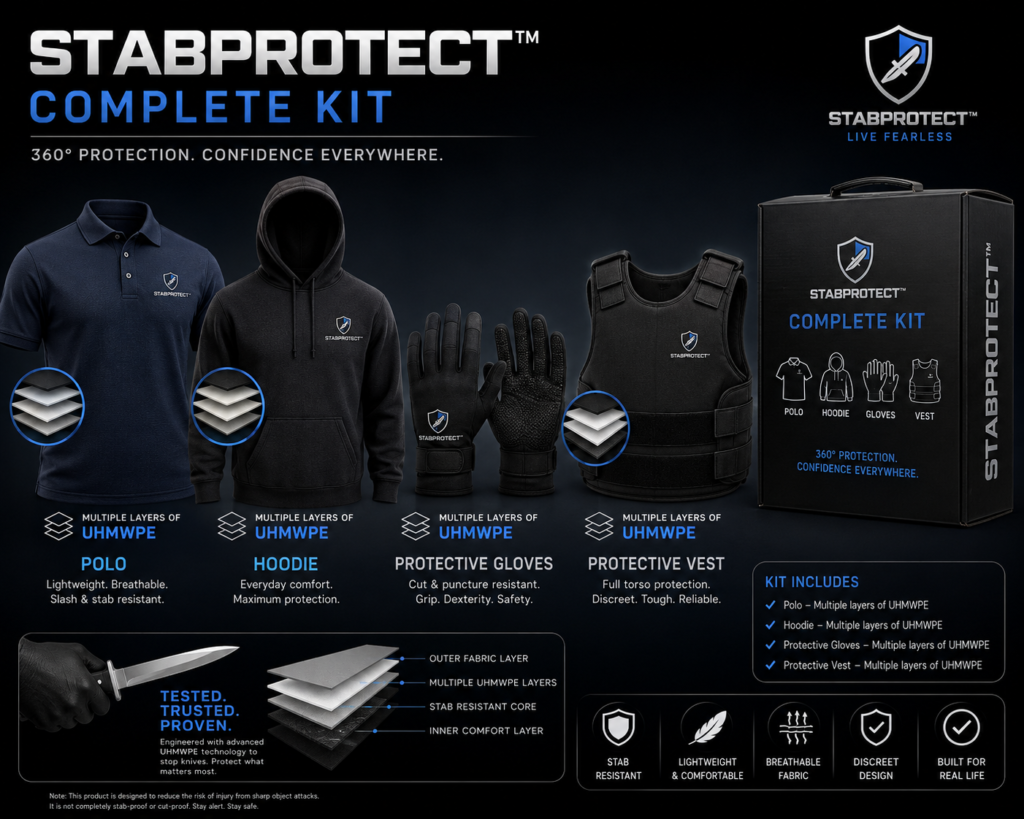
This article on protective workwear presents a comprehensive commercial and strategic case for STABAPPAREL PROTECTIVE WORKWEAR™ a pioneering new product category that redefines the relationship between professional corporate attire and personal protective equipment (PPE). The core concept is elegantly simple yet commercially profound: corporate and security workwear that appears entirely conventional from the exterior while incorporating an engineered, high-performance protective construction within the garment itself.
The proposition directly addresses a critical tension prevalent across the security, facilities management, and front-of-house sectors. Employers are under increasing pressure to present a professional, approachable, and brand-consistent image to the public. Simultaneously, they have a fundamental duty of care to protect their employees from the physical risks inherent in public-facing roles. Historically, these two objectives have been diametrically opposed. Overt PPE, such as stab vests, plate carriers, and tactical garments, visually signals risk and can alienate staff from the corporate environments they serve. Conversely, standard corporate uniforms offer no tangible physical protection whatsoever.
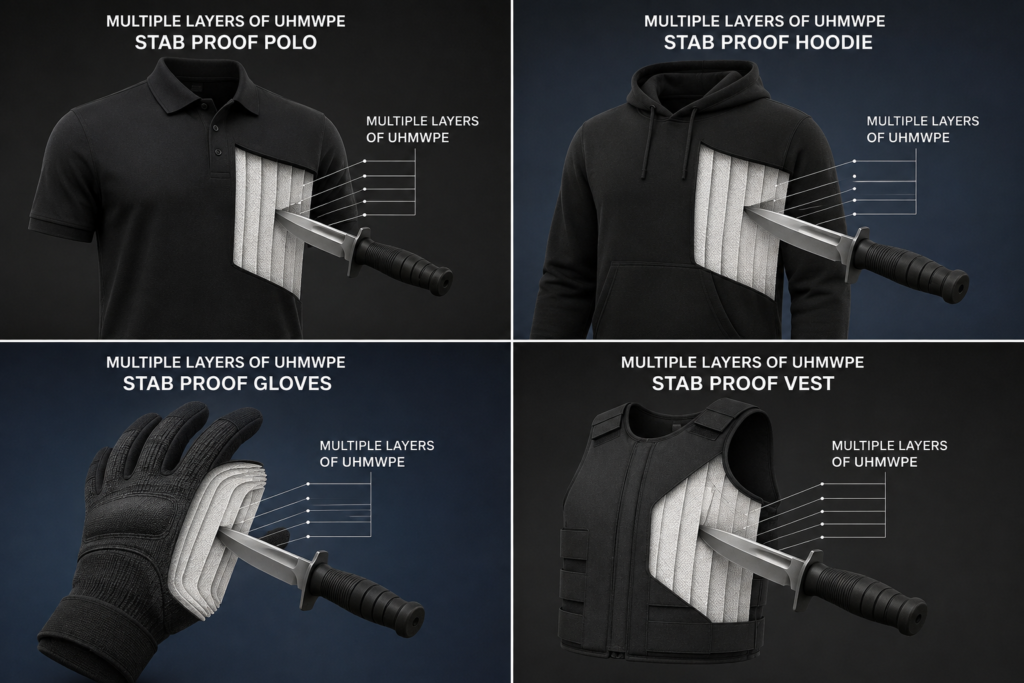
STABAPPAREL PROTECTIVE WORKWEAR™ is engineered to resolve this dilemma. The garments are constructed to be visually indistinguishable from standard corporate uniforms, with proprietary layers of UHMWPE (Ultra-High Molecular Weight Polyethylene) fibre-reinforced composite material integrated seamlessly into the garment’s architecture.
Crucially, this document serves as a strategic and commercial exploration. It is not a technical specification, a certified product claim, nor a confirmation that any garment currently exists in a tested, market-ready form. Its purpose is to equip Stabapparel’s leadership with a deep understanding of the market opportunity, the competitive landscape, and the rigorous discipline required to bring this innovation to market responsibly.
Throughout this assessment, we maintain a clear, disciplined distinction between:
- Established Fact: The material properties of UHMWPE, current market operations.
- Industry Observation: The typical behaviour of procurement teams and buying committees.
- Strategic Hypothesis: The anticipated market response to this specific proposition.
- Product-Development Assumption: The necessary engineering and validation requirements.
- Future Opportunity: Potential category extensions contingent on successful validation.
No claims are made regarding existing certifications, test results, confirmed customers, or specific protection levels. Where such outcomes are discussed, they are presented as critical requirements for further development and validation, not as settled facts.
PART 1: The Core Concept & Market Disruption
Chapter 1: The Next Evolution of Professional Security Workwear
Imagine a visitor arriving at the reception of a corporate headquarters in central London. They are greeted by a member of the security team: a sharp, branded polo shirt, pressed trousers, an ID badge, and a calm, professional demeanour. The encounter is seamless, reflecting a well-run, modern establishment. Nothing in this scene suggests protective equipment, and that is precisely the point.
Within the fabric of that polo shirt – in the version of this concept explored herein – lies an engineered protective construction: layers of UHMWPE fibre-reinforced composite material built into the garment rather than worn over it. The wearer presents exactly as a professional security officer should. Yet beneath that conventional exterior, the garment itself has been meticulously designed to provide an additional layer of protective performance, subject to the rigorous engineering, testing, and certification such a claim would necessitate.
This is the fundamental proposition of STABAPPAREL PROTECTIVE WORKWEAR™:
What if protective workwear did not have to look like protective equipment?
While the question is deceptively simple, its implications are profound, touching every stakeholder in the security and facilities workwear supply chain:
- Security Companies: Need to win and retain corporate contracts.
- Procurement Managers: Must balance cost against their duty of care.
- Operations Directors: Need to ensure staff safety without alarming the public or clients.
- End Users (Officers): Must wear the garment comfortably, every day, for years.
If this concept can be engineered, tested, and validated to a credible standard, it represents a seismic shift in the industry. It transforms the relationship between uniform and protection from two separate purchases from two separate suppliers, worn as two separate layers, into a single, integrated, and intelligent garment system.
This paper explores that opportunity in its entirety: the market problem it solves, the commercial and technical questions it raises, the buyers who must be persuaded, the claims that must be earned, and the path Stabapparel must walk to bring this concept to market with integrity and authority.
PART 2: The Market Problem – The Status Quo
Chapter 2: The Duality of the Modern Security Officer
The role of security personnel has evolved significantly. In corporate, retail, hospitality, and transport environments, the security officer is no longer just a gatekeeper. They are often the first and last point of human contact for visitors, customers, and employees. They are expected to project calm authority, be approachable enough to offer directions, and be sufficiently capable to manage an incident if one arises.
This dual role is now standard across key market sectors:
- Corporate Offices: Reception security is visually indistinguishable from front-of-house staff.
- Hotels: Security personnel must uphold the same guest experience standards as concierge staff.
- Retail: Loss-prevention staff operate on the shop floor, interacting directly with customers.
- Transport Hubs: Security staff balance regulation enforcement with managing high volumes of public interaction.
- Event Venues: Event security is a visible part of the customer experience.
- Healthcare: Non-clinical security staff work in emotionally sensitive environments requiring a calm, professional presence.
In each setting, the officer performs multiple roles: security presence, incident responder, customer service representative, building ambassador, and informal concierge. Consequently, appearance is a commercial specification. Corporate clients are increasingly explicit in their procurement specifications regarding presentation standards, as the officer’s appearance directly reflects on the client’s brand.
Any protective product targeted at this market must therefore be judged not only on its protective performance but also on its ability to meet these rigorous presentation standards without compromise. This is the non-negotiable starting condition.
Chapter 3: The Visibility Problem – Cost of a Tactical Appearance
If appearance is paramount, then anything worn on top of, or visibly integrated into, a uniform carries a significant cost alongside any potential benefit. This chapter explores that cost as a critical industry consideration.
What happens when protective equipment looks too tactical?
Security operators, facilities managers, and corporate clients may consciously or subconsciously weigh several factors when visible protective equipment is introduced:
- Perceived Intimidation: Overt PPE (plate carriers, tactical vests) can signal an elevated threat level to the public, even when none exists.
- Militarisation of Civilian Spaces: Corporate lobbies and retail floors are civilian environments; military or law-enforcement aesthetic can sit uneasily within them.
- Reduced Approachability: A less visually accessible presentation can deter the public from approaching staff for assistance.
- Visual Inconsistency: Overt equipment can jar against the considered brand environment of a client.
- Brand Dilution: Security companies that market themselves on professionalism and discretion may find a visibly “armoured” workforce contradictory.
This is not an argument against visible PPE, which remains entirely appropriate and necessary in higher-risk contexts. The point is narrower: a significant market segment – day-to-day corporate, retail, hospitality, and facilities security – deems visible equipment operationally unsuitable, resulting in personnel wearing no additional physical protection beyond their standard uniform. That gap is the commercial space this paper addresses.
PART 3: The Product – Engineering and Material Science
Chapter 5: Introducing STABAPPAREL PROTECTIVE WORKWEAR™
At its essence, the concept is defined by three core principles:
- Outside: A professional corporate uniform garment – polo shirt, shirt, jacket, waistcoat, or overshirt – indistinguishable in appearance from a standard equivalent.
- Inside: An engineered protective construction incorporating UHMWPE fibre-reinforced composite material, appropriately specified for the garment format.
- Purpose: To deliver additional protective performance as part of the garment the wearer would don regardless, rather than as a separate item of equipment.
This concept can be applied across various garment formats, including:
- Polo Shirts
- Corporate Shirts
- Jackets & Softshells
- Waistcoats & Gilets
- Overshirts
Important Note: Not every garment format is automatically technically suitable. Engineering challenges (weight distribution, flexibility, coverage, laundering) vary significantly. Each product would require independent design, engineering, and validation – a foundational assumption of this strategy.
Chapter 6: What is UHMWPE? Understanding the Technology
UHMWPE (Ultra-High Molecular Weight Polyethylene) is a form of polyethylene distinguished by its extremely long polymer chains, which grant it a unique combination of physical properties relevant to protective textiles:
- Exceptional Strength-to-Weight Ratio: Offers high tensile strength relative to its weight, a key factor for wearer comfort.
- High Tensile Performance: Resistant to being pulled apart under load.
- Low Density: Lighter than many alternative high-performance fibres.
- Abrasion Resistance: Withstands surface wear well, crucial for garment durability and laundering.
However, a critical distinction must be made:
The properties of a raw material do not automatically translate into a specific, guaranteed level of protection in a finished garment.
Protective performance depends on numerous factors beyond the base fibre:
- Fibre architecture, weave, and laminate structure.
- The composite system (resins, layering, bonding).
- Number and orientation of layers.
- Coverage area and garment pattern design.
- Seam construction (often the weakest point).
- Fit and how the garment moves with the body.
- Performance after laundering and repeated wear.
- Manufacturing consistency and quality control.
- Independent testing against a defined, recognised standard.
For this reason, this paper deliberately avoids claiming any garment is “stab-resistant” or “protective” by virtue of its material alone. Such claims can only be made once a specific, finished garment has been tested against a defined standard by an accredited body.
Chapter 7: The Protective Layer Within – Conceptual Architecture
A simplified three-layer system describes the proposed garment architecture:
- Layer 1 – Corporate Outer Garment: The visible, branded fabric meeting professional standards of comfort, appearance, and laundering.
- Layer 2 – Protective Construction: The engineered UHMWPE-based composite system, positioned according to risk assessment and design requirements.
- Layer 3 – Comfort and Interface Layer: Manages next-to-skin comfort, moisture, and fit to ensure the protective layer does not compromise wearability.
Critical Development Variables:
- Flexibility: Does the garment allow natural movement?
- Breathability: How does the garment perform thermally over a shift?
- Weight: What is the total added weight, and is it evenly distributed?
- Temperature: Does the garment cause heat build-up?
- Laundering: Can the garment be washed without degrading performance?
- Durability: How does protection change over the garment’s working life?
- Seams & Closures: How are weak points addressed?
PART 4: The Customer Value Proposition
Chapter 8: Why Security Companies Don’t Want “Armour”
Security companies are not purchasing PPE because they want their workforce to look protected. They purchase it because they have a duty of care, a contractual obligation to manage risk, and a need to retain staff.
What they actually want is:
“Our staff look professional and have additional protection.”
This single sentence resolves the central tension. It does not ask the buyer to choose between a professional workforce and a protected one. It proposes both can be true simultaneously. This is a powerful, differentiated commercial proposition that is currently underserved by the existing market.
Chapter 9: From “Protective Equipment” to “Protective Uniform”
This is a fundamental shift in buyer psychology:
- Traditional Framing: “Here is your uniform. Here is your protective equipment.”
- Proposed Framing: “Your uniform can incorporate protective capability.”
The traditional framing positions protection as an additional cost, item, and decision. The proposed framing collapses the decision into the uniform procurement process. If protective capability is simply a specification option within the garment a company was already buying, the purchasing conversation changes completely. This strategic hypothesis suggests that integrating protection into the uniform-buying decision could significantly increase adoption rates across the eligible workforce.
Chapter 10: Protection Without Compromising Brand Image
Corporate branding is central to how security contractors win and retain work. Logos, colour palettes, and embroidery specifications are often written directly into client contracts.
Any protective product must therefore sit entirely within existing brand guidelines. The manufacturing process must accommodate standard corporate customisation (embroidery, colour matching) without disrupting the protective construction. A garment that forces a compromise on brand presentation introduces friction that a purely aesthetic supplier does not.
PART 5: The Market Opportunity – Sectors and Scale
Chapter 11: Why the Opportunity is Bigger Than Security
While security is the natural entry point, the proposition has relevance across adjacent sectors:
- Facilities Management: Front-of-house staff and mobile response personnel face public-facing roles with unpredictability.
- Transport: Station personnel and transport security operate in high-footfall environments.
- Healthcare (Non-Clinical): Security and estate roles in sensitive healthcare settings.
- Retail: Loss-prevention staff operating directly among customers.
- Hospitality: Hotel and venue staff who project warmth while managing unpredictable behaviour.
Strategic Implication: STABAPPAREL should be positioned as a cross-sector proposition, with security as the primary entry point. The go-to-market strategy should start narrow and expand only after core validation.
Chapter 12: The Platform Opportunity – Building a Product Family
The commercial mistake would be to treat this as a single product. The stronger framing is as a protective workwear platform.
A plausible future product family, under the STABAPPAREL PROTECTIVE WORKWEAR™ name, might include:
| Product | Primary Use Case | Development Priority |
|---|---|---|
| Protective Polo | Reception, front-of-house, retail security | First-priority pilot garment |
| Protective Shirt | Corporate/formal security, front-of-house | Near-term follow-on |
| Protective Jacket | Outdoor mobile security, transport, events | Medium-term, higher complexity |
| Protective Waistcoat | Layerable option across roles and seasons | Medium-term |
| Protective Overshirt | Casual-professional facilities and hospitality | Longer-term |
Each entry is a potential product, not a confirmed roadmap. The platform narrative is valuable strategically, but must not create pressure to launch faster than responsible engineering allows.
PART 6: The Buyer – Understanding the Decision-Making Unit
Chapter 13: The Buying Committee
Selling into the security workwear market involves a buying committee, not a single decision-maker. This map includes:
- Managing Director/CEO: Differentiation, contract retention, reputational risk.
- Operations Director: Operational practicality, staff retention, deployment consistency.
- Procurement Manager: Specification, total cost, supplier reliability, compliance.
- Contract Manager: Meeting client presentation and service standards.
- Health & Safety Lead: Risk assessment alignment, testing evidence.
- Security Director: Genuine protection without degrading operational effectiveness.
- Facilities Manager (Client-Side): Reflection on their own brand and estate.
- Finance: Unit economics and total cost of ownership.
- HR: Employee welfare and staff retention.
- Employee Representatives: Comfort and genuine wearer benefit.
- End Users (Officers): Comfort, appearance, and an improved working day.
Marketing Implication: Distinct messaging tracks are required for commercial, technical, and end-user audiences.
Chapter 14: The Procurement Argument – A Data-Driven Case
The product must survive a hard-nosed procurement conversation. A credible case must address:
- Cost per Wearer: Inclusive of sizing and customisation.
- Lifecycle Cost: Amortised over the working life, not just the up-front price.
- Durability: Performance under realistic daily wear.
- Replacement Cycle: Clear triggers for replacement.
- Laundering & Maintenance: Compatibility with existing arrangements.
- Standardisation: Ability to specify a single garment across a diverse workforce.
- Branding: Full compatibility with corporate identity.
- Supplier Reliability: Consistent stock availability and lead times.
- Certification & Testing: Independent, verifiable evidence supporting claims.
PART 7: The Human Factor – Wearer Acceptance
Chapter 15: What Does the Wearer Think?
Procurement decisions are made at the top, but garments are worn by individuals. A product that fails in the field due to poor comfort or compliance will ultimately fail commercially.
Potential benefits worth investigating directly with wearers include:
- A sense of increased confidence in unpredictable situations.
- Enhanced professionalism, distinct from feeling “kitted out.”
- Physical comfort comparable to or better than existing uniform.
- Stronger personal and professional identity.
- Reduced self-consciousness compared with visibly worn equipment.
These are hypotheses requiring customer research, not confirmed outcomes. Any wearer-benefit messaging must be grounded in structured feedback from pilot programmes (see Chapter 27), not asserted in advance.
Chapter 16: Dignity, Confidence, and Professional Identity
Workwear communicates how an employer views its workforce. A well-considered uniform is read as a sign of investment and respect. Integrated protective workwear may allow an employer to demonstrate investment in welfare without requiring the individual to visually present as a combatant or to feel singled out. The protection is a private fact about the garment, not a public statement about the wearer’s vulnerability. This narrative should be validated through direct engagement with real wearers.
PART 8: Product Design and Engineering
Chapter 17: Designing Protection Around the Human Being
Comfort is the determining factor in whether a garment is worn correctly and consistently. Design work must address:
- Ergonomics: How the garment moves with the body.
- Mobility: Freedom to reach, bend, crouch, and move quickly.
- Fit: Accuracy across a diverse workforce.
- Weight Distribution: Avoiding localised discomfort.
- Heat & Moisture Management: Thermal performance across a shift.
A protective garment that is too hot, heavy, stiff, or restrictive risks poor adoption, undermining the entire value proposition regardless of the protective layer’s quality.
Chapter 18: Designing for Everyday Wear
This is protective equipment for routine, daily professional use, not occasional deployment. This introduces critical design considerations:
- Repeated Wearing: Cumulative stress across hundreds of shifts.
- Washing: Compatibility with realistic laundering regimes and limitations.
- Storage: How the protective layer behaves under realistic storage conditions.
- Inspection: Practical means to check if the garment remains fit for purpose.
- Replacement: Clear guidance on lifespan and replacement triggers.
Discipline Point: A garment’s performance on day one is not its performance after a year of daily wear and 200 wash cycles. Any claims programme must account for this explicitly.
PART 9: Differentiation and Category Creation
Chapter 21: The Category-Creation Opportunity
If the concept can be proven, Stabapparel has the opportunity to define a new category. Three plausible category names are:
- “Protective Corporate Workwear”: Clear, commercial, but relatively generic.
- “Integrated Protective Workwear”: Precisely describes the core mechanism; resonates with technical buyers.
- “Discreet Protective Workwear”: Captures the emotional core but requires careful copywriting.
Recommendation: Use “Integrated Protective Workwear” as the formal B2B category descriptor, while “Professional on the outside. Protective within.” carries the emotional weight in customer-facing communications.

Undetectable Knives and Blades
PART 10: Marketing Strategy – Building Authority
Chapter 22: Selling the Outcome, Not the Material
Customers do not buy UHMWPE. They buy outcomes:
- Professional Appearance that meets client and brand standards.
- Genuine Additional Protection for their workforce.
- Confidence in discharging their duty of care.
- Operational Practicality that doesn’t disrupt the day-to-day.
- Brand Consistency across every site.
- Risk-Management Value.
UHMWPE functions as proof to answer “why should I believe this works?” after the proposition has been made in terms of outcomes.
Chapter 23: The Message Architecture
Primary Message:
Professional on the outside. Protective within.
Supporting Message:
Corporate workwear designed with additional protective capability integrated into the garment.
Commercial Message:
Help your security teams look professional without compromising your commitment to employee protection.
Additional Message Pillars (Audience-Specific):
- For the MD: “A differentiated offer your competitors cannot simply replicate with a standard uniform order.”
- For the Procurement Manager: “One specification decision, not two separate purchases.”
- For the Health & Safety Lead: “Protective engineering, tested and documented – not a marketing assertion.”
- For the Operations Director: “A uniform your officers will actually want to wear, every shift.”
- For the Corporate Client: “Security presence that reflects your brand, not a tactical presence that works against it.”
PART 11: Commercial Model and Piloting
Chapter 26: From Garment to Recurring Revenue
Several commercial models are worth exploring:
- Direct Sales: Per-unit sales to security and facilities companies.
- Uniform Contracts: Integration into multi-year uniform supply contracts.
- Managed Programmes: Full-service supply, sizing, replacement, and account management.
- Custom Branding Services: Value-added service layer.
Core Commercial Model:
Revenue per wearer × number of wearers per contract × replacement frequency.
Chapter 27: The Pilot Strategy – Validating the Product
Before any commercial rollout, a structured pilot programme is critical to generate first-party evidence. A hypothetical pilot framework would test:
- Comfort: Feedback across a full shift pattern over several weeks.
- Acceptance: Willingness of officers to wear the garment consistently.
- Appearance: Feedback from wearers and client-side stakeholders.
- Usability: Practical fitness for the specific role.
- Laundering: Real-world outcomes against manufacturer guidance.
- Durability: Visible wear and performance change over the pilot period.
- Fit: Accuracy of sizing across a diverse cohort.
- Procurement Response: A candid readout on whether the product met criteria.
Pilot outcomes must feed directly and honestly into product development.
PART 12: Trust, Testing, and Credibility – The Non-Negotiables
Chapter 28: The Most Important Word: Evidence
This section is non-negotiable.
Protective products cannot be marketed responsibly through attractive claims alone. The sector is populated by sophisticated buyers who expect claims to be backed by evidence.
The evidence discipline required includes:
- Independent Testing: By a laboratory with no commercial interest.
- Recognised Standards: Conducted against defined, appropriate performance standards.
- Appropriate Certification: Pursuing relevant certifications properly.
- Laboratory Validation: Documented, repeatable test results.
- Documentation: Clear records for procurement managers to review.
- Traceability: Ability to trace a garment back to its test data.
- Quality Assurance: Manufacturing controls to ensure tested performance is representative.
No certifications, results, or accreditations are implied in this document.
Chapter 29: Claims Must Follow Testing
A precise distinction must be maintained between marketing language and verified technical claims.
Terms such as “stab-resistant,” “spike-resistant,” “cut-resistant,” are specific, technical claims. They can only be used where properly substantiated by specific, finished garment testing.
Until that evidence exists, measured and honest language must be used, such as:
- “designed to provide additional protection”
- “protective construction”
- “engineered protective layer”
- “subject to appropriate testing and certification”
PART 13: Brand Strategy – The Professional Identity
Chapter 30: Making Protection Feel Professional
The brand personality for STABAPPAREL PROTECTIVE WORKWEAR™ should be built around:
- Confident: Assured without overselling.
- Understated: Reflecting the discreet nature of the product.
- Sophisticated: Appropriate for a senior B2B audience.
- Technical: Comfortable engaging with genuine engineering detail.
- Dependable: The tone of a supplier you can rely on.
- Discreet: Echoing the product’s core proposition.
- Modern: Contemporary, avoiding dated workwear conventions.
- Professional: Restrained and credible for boardroom conversations.
Crucially, the brand must not rely on fear as a persuasive mechanism. It risks alienating the sophisticated, safety-conscious buyers this product is aimed at.
Chapter 31: The Visual Identity
Marketing visuals must communicate a single idea: ordinary corporate uniform on the outside, hidden technical capability within. Creative devices to explore include:
- Cutaway Garment Imagery: A technical diagram showing layered construction.
- Exploded-Layer Diagrams: Visualisation of the three-layer structure.
- Close-up Textile Photography: Macro photography communicating engineering quality.
- Professional Security Environments: Photography in real corporate, retail, or hospitality contexts.
Graphic depictions of violence or dramatised threat scenarios should be avoided entirely.
PART 14: Objections and the Competitive Landscape
Chapter 34: “Will It Be Too Hot?”
Recommended Response: Acknowledge the concern directly; explain the design intent to manage thermal comfort; commit to wearer trials across realistic UK seasonal conditions as the only credible answer.
Chapter 35: “Will It Be Expensive?”
Recommended Response: Address total value directly (employee welfare, procurement simplification, lifecycle cost, risk management). Discuss price openly once a genuine cost structure exists.
Chapter 36: “How Do I Know It Actually Protects?”
Recommended Response: Provide, once available, independent test documentation from an accredited laboratory.
Chapter 37: “Will Our Staff Actually Wear It?”
Recommended Response: Reference structured pilot feedback and acceptance/compliance data.
PART 15: Go-To-Market Strategy – The First 12 Months
Chapter 40: The First 12 Months – A Phased Approach
A realistic, phased approach with clear decision gates:
- Phase 1 – Research & Validation: Confirm the market problem with target customers.
- Decision Gate: Is the problem genuinely recognised by real buyers?
- Phase 2 – Prototype Development: Develop the first garment (recommended: the polo).
- Decision Gate: Does the prototype meet baseline comfort and appearance standards?
- Phase 3 – Independent Testing: Submit the prototype for independent testing.
- Decision Gate: Does the tested performance support a credible claim?
- Phase 4 – Pilot Customers: Run the structured pilot programme with engaged customers.
- Decision Gate: Does pilot feedback support proceeding to launch?
- Phase 5 – Refinement: Address issues surfaced during piloting.
- Phase 6 – Commercial Launch: Launch with fully substantiated claims and complete documentation.
- Phase 7 – Scale: Expand across the garment family and sectors.
This structure is deliberately conservative. Moving faster than the evidence supports is a materially greater risk than a slower timeline.
PART 16: STABAPPAREL PROTECTIVE WORKWEAR™– The Strategic Thesis
Chapter 43: Professional Outside. Protective Within.
Return to the security officer in the corporate lobby: branded polo shirt, professional presence, indistinguishable from any other front-of-house team member.
Nothing about that scene has changed. The officer still looks professional, the brand identity is intact, and the employee remains outwardly themselves.
What has changed is what sits beneath the surface of that ordinary appearance – if, and only if, Stabapparel does the genuine work: careful engineering, rigorous independent testing, real pilot validation, and a marketing approach built on evidence, not assertion.
STABAPPAREL PROTECTIVE WORKWEAR™ could become more than a product line. It could become a new category, a genuine product platform, and a significant growth engine for Stabapparel. This outcome is not guaranteed. It depends on:
- Rigorous product engineering.
- Genuinely independent testing.
- Honest customer validation.
- Disciplined, evidence-led claims.
- Real manufacturing capability.
- Genuine procurement and wearer acceptance.
If Stabapparel is willing to do that work with the patience and discipline it requires, the fundamental question at the heart of this proposition is one worth putting to the market:
If your people need to look professional, why should additional protection require them to look like they are wearing protective equipment?

STABAPPAREL PROTECTIVE WORKWEAR™ Appendices
Appendix A – Customer Personas
1. Security Company Managing Director
- Primary Concerns: Contract retention, differentiation, margin, employee retention, reputational risk.
- Responds to: Category-defining strategic narrative, evidence of genuine differentiation, credible commercial case.
2. Procurement Manager
- Primary Concerns: Specification accuracy, total cost, compliance, supply reliability, lifecycle cost.
- Responds to: Detailed procurement argument, complete and accurate documentation, straightforward cost structure.
3. Security Operations Director
- Primary Concerns: Operational practicality, employee adoption, consistency, genuine risk management.
- Responds to: Pilot evidence, comfort and design rigour, honest acknowledgement of operational trade-offs.
4. Security Officer (End User)
- Primary Concerns: Comfort, appearance, freedom of movement, personal confidence.
- Responds to: Direct, respectful engagement, genuine comfort and fit, messaging that respects their professionalism.
5. Corporate Client
- Primary Concerns: Professional presentation reflecting their own brand, visitor experience, appropriate risk management.
- Responds to: Presentation and brand-consistency argument, confidence that their contractor is managing risk responsibly.
Appendix B – Competitive Positioning Matrix
| Attribute | Standard Uniform | Traditional PPE | Tactical Apparel | STABAPPAREL (Concept) |
|---|---|---|---|---|
| Professional Appearance | High | Low–Moderate | Low | High |
| Protective Capability | None | High (Context-Dependent) | High | To be established |
| Discretion | High (Protection Absent) | Low | Very Low | High (By Design) |
| Comfort (All-Day Wear) | High | Variable | Variable | To be established |
| Corporate Suitability | High | Low | Very Low | High (If Validated) |
Appendix C – SWOT Analysis
| Strengths | Weaknesses |
|---|---|
| • Genuinely differentiated core concept. | • Significant product-development and testing cost. |
| • Addresses a real, unmet market tension. | • Technical challenges (heat, weight, comfort). |
| • Potential for discreet integration. | • Manufacturing complexity vs. standard uniform. |
| • Strong alignment with corporate branding. | • No existing evidence base. |
| Opportunities | Threats |
| • Multiple adjacent sectors (Facilities, Retail). | • Established competitors with far greater scale. |
| • Genuine platform and category-creation opportunity. | • Challenging regulatory/certification requirements. |
| • Potential for premium positioning and long-term accounts. | • Customer price sensitivity. |
| • International market potential. | • Reputational risk from unsupported claims. |
Appendix D – Customer Objections Table
| Objection | Recommended Response | Evidence Required |
|---|---|---|
| “It will be too hot.” | Acknowledge; explain design intent; commit to seasonal trials. | Pilot data across seasons. |
| “It will look bulky.” | Explain discreet design intent; offer physical samples. | Independent visual assessment. |
| “How do I know it works?” | Provide, once available, independent test documentation. | Accredited lab certificates. |
| “It will cost more.” | Present total-value case (lifecycle, procurement simplification). | Costed lifecycle comparison. |
| “Will it survive washing?” | Confirm compatible laundering guidance once tested. | Laundering-cycle degradation testing. |
| “Can it be embroidered?” | Confirm compatibility with standard branding processes. | Sample branded garments. |
| “Will staff wear it?” | Reference structured pilot feedback. | Pilot acceptance and compliance data. |
| “Is it certified?” | State current status honestly; do not imply certification. | Certification documentation, once obtained. |
Appendix E – Brand Message House
Master Proposition: Professional on the outside. Protective within.
- Pillar 1 – Professionalism: The garment meets corporate uniform expectations.
- Pillar 2 – Protection: Incorporates engineered construction, tested and documented.
- Pillar 3 – Discretion: Protective capability is present without being visually apparent.
- Pillar 4 – Comfort: Designed for everyday, all-shift wear.
- Pillar 5 – Corporate Identity: Fully compatible with branding and customisation.
- Pillar 6 – Evidence & Trust: Every claim is backed by appropriate testing.
Appendix F – Sample Marketing Copy
Website Headline:
Professional on the outside. Protective within.
Website Subheadline:
Corporate security workwear engineered with additional protective capability built into the garment – not worn on top of it.
LinkedIn Post (Draft):
Security teams shouldn’t have to choose between looking professional and being better protected. We’re exploring what protective corporate workwear could look like when the protection is built into the uniform itself – not added on top of it. More to come.
B2B Sales Email (Draft Opening):
Subject: A different way to think about your security uniform.
Hi [Name],
Most security teams face the same trade-off: overt protective equipment can look at odds with a professional, client-facing environment – while standard uniform offers no additional physical protection at all.
We’re developing an approach designed to remove that trade-off entirely. I’d welcome the chance to talk you through it.
Appendix G – SEO Strategy Notes
Primary Keyword Theme: protective corporate workwear / integrated protective workwear
Secondary Keyword Themes:
- protective security uniforms
- security workwear
- discreet protective clothing
- corporate protective clothing
- UHMWPE protective clothing
- protective polo shirts
- professional security uniforms
Search Intent Mapping:
- Informational: “what is UHMWPE” → Technical Explainer Content.
- Commercial Investigation: “protective security uniforms UK” → Product/Category Pages.
- Procurement Intent: “security uniform supplier specification” → Procurement/Specification Page.
Appendix H – Frequently Asked Questions
1. What is STABAPPAREL PROTECTIVE WORKWEAR™?
A proposed category of corporate and security uniform designed to look conventional, while incorporating an engineered protective construction within, subject to appropriate testing and validation.
2. What is UHMWPE?
Ultra-High Molecular Weight Polyethylene – a polymer fibre recognised for its high strength-to-weight ratio, low density, and abrasion resistance.
3. Does using UHMWPE automatically make a garment stab-resistant?
No. Protective performance depends on the complete garment system, not the base material alone.
4. How does integrated protective workwear differ from conventional PPE?
Conventional PPE is worn visibly, over the uniform. Integrated protective workwear is designed to be visually indistinguishable from standard uniform.
5. Can the garment be branded?
In principle, yes. Full compatibility with corporate branding, embroidery, and colour-matching is a core design requirement.
6. Is the garment suitable for everyday use?
That is the specific intent. It must be verified through durability, laundering, and comfort testing appropriate for daily, long-term wear.
7. How should protective garments be tested?
Against recognised, appropriate independent standards, by accredited laboratories, on the specific, finished garment construction.
8. What claims can legitimately be made?
Only those directly supported by independent testing of the specific, finished garment.
